How much ChatGPT ads cost, and whether they're worth it for your business
ChatGPT ads have no total minimum spend for self-serve accounts, a minimum daily budget of $25 (EUR 15, GBP 15), and are billed per click or per thousand impressions, never per conversion. Every published advertiser result in one table, what changes with Target CPA on November 9, and a checklist for deciding whether to test.
How much do ChatGPT ads cost, and are they worth it?
By Andrej Ruckij · November 6, 2026
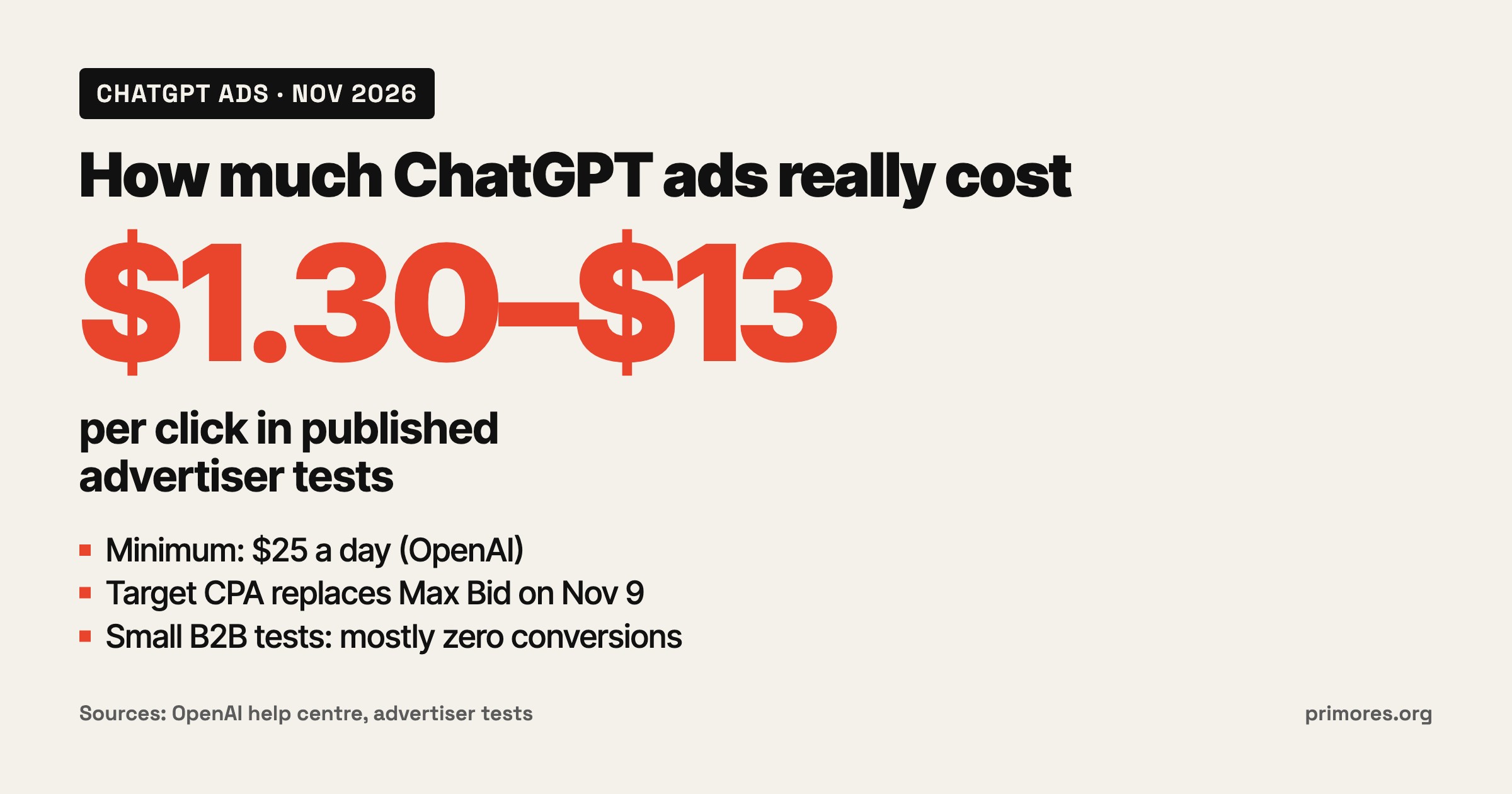
TL;DR: You buy ChatGPT ads on views (CPM), clicks (CPC) or conversions, and even conversion campaigns are billed per click or per impression, never per conversion. There’s no total commitment for self-serve; the minimum daily budget is $25 in the US, EUR 15 or GBP 15. Published advertiser tests paid roughly $1.30 to $13 per click, with single markets up to about $23. What they got splits cleanly. Two advertisers report positive return on ad spend: Common Thread Collective’s ecommerce test on about $9,600 (relayed second-hand) and an Opascope client on about $60,000. Every small B2B or niche test that published conversions reports zero or close to it. From November 9, Target CPA replaces Max Bid for new conversion campaigns, and OpenAI warns that weak or missing conversion signals can reduce delivery. It suits consumer ecommerce with working purchase tracking and a few thousand dollars to spend; for a niche B2B offer on a $1,000 budget, I’d skip it for now.
ChatGPT does have ads, and most businesses in allowed categories can now buy them self-serve, though some new accounts start limited to their home country. The pilot that opened in February started at a $60 CPM with a $200,000 minimum commitment (PPC Land). Today a small business can open an account and spend $25 a day. The question is whether that $25 buys anything, and the honest answer is that it depends almost entirely on what you sell and how many conversions you can measure.
OpenAI’s terms checked on its help pages on November 6, 2026. Everything about price, billing, minimums, bidding and categories below comes from those pages. Advertiser results come from the advertisers or agencies that published them, and each one is labelled.
What you pay for
Objectives and billing. When you create a campaign you “choose Views (CPM), Clicks (CPC), or Conversions” (OpenAI help: creating campaigns). Conversion campaigns still bill per click or per thousand impressions, in OpenAI’s words “valid clicks (oCPC) … or impressions served (oCPM)”, and the page says plainly: “You do not pay per conversion.”
How the price is set. It’s an auction. “The final winning auction bid sets the price you pay,” and a target “is not a fixed price per conversion or click, and actual average costs may be higher or lower than your target” (OpenAI help: bidding and pricing).
Minimum daily budget, from OpenAI’s campaign help page:
| Billing currency | Minimum daily budget |
|---|---|
| USD | 25 USD |
| EUR | 15 EUR |
| GBP | 15 GBP |
| CAD | 25 CAD |
| AUD | 25 AUD |
The daily budget works as a 7-day average, and “daily spend will not exceed twice your selected daily budget” (OpenAI help: creating campaigns). So a $25 budget can spend $50 on a single day. Over 30 days, the floor works out to about $750.
Where you can advertise. “Some new self-serve ad accounts can initially advertise only in their home country” until “identity verification is approved and you reach the required advertising spend”. The page doesn’t say what that spend is. If you only want US traffic, OpenAI says to “explicitly include the United States in your campaign locations.”
Which categories are allowed. From OpenAI’s ad policies (updated September 10, 2026): “During the initial test period, ads are primarily limited to consumer verticals such as lifestyle and household goods, local services, travel and experiences, and digital products or education.” Financial services, healthcare and legal get “approvals being reviewed manually on a case-by-case basis”, in the US only; “ads for financial services outside the US are generally prohibited”, and the same goes for health. Disallowed outright: dating and adult, alcohol and tobacco, gambling, political content, recreational drugs, individual job or housing listings, and wellness products with unsupported health claims. One clause worth knowing if you sell an AI product: OpenAI may decline ads that “conflict with our advertising principles, business interests, or competitive position.”
Every published advertiser result
This is every result with numbers I could find, as of November 6, 2026. Labels: measured by the advertiser (its own campaign, numbers published), small test (the same, under about $5,000), vendor-reported (an agency selling the channel, or OpenAI, with no sample disclosed), second-hand (a LinkedIn post relayed by press, original not located).
| Advertiser | Type | Spend | CPC | CTR | Outcome | Evidence |
|---|---|---|---|---|---|---|
| Opascope client | Not stated (“a live account”) | ~$60,000 in 15 days | ~$1.72 | not given | 2.35% conversion rate, ~$89k revenue, 1.49x blended ROAS (daily 0.2x to 2.9x) | Measured by the advertiser’s agency; only campaigns whose budgets were increased are shown (TTMS) |
| Hostinger | Web hosting | ~$70,000 | ”weren’t higher than Google Search” | lower than Google | ”some later purchases”, profitability unclear; CPM above $65 | Second-hand |
| Common Thread Collective | Ecommerce | $9,620 | $4.41 | 0.94% | $19k to $38k attributed revenue depending on attribution model (3.3x to 6.8x est.) | Second-hand |
| Floyd Blaikie | B2B | ~CA$7,000 | CA$9.29 | 0.7% | 336 clicks, 146 organisations identified, “only five matched its ideal customer profile” | Second-hand |
| Synter | B2B SaaS, 5 markets | $4,428.84 | $9.89 (US $10.62, UK $5.10, NZ $22.89) | 0.35% | Trial signups “too small … to publish” | Small test (Synter sells AI ad tools) |
| Workshop Digital | B2B agency | $2,319 | $3.14 | 1.1% | 0 MQLs (its Google Search: $6.76 CPC, 5.2% CTR, 2 MQLs) | Small test |
| Windmill Strategy | B2B industrial | $1,470 | $5.68 | 0.66% | 0 tracked conversions in a month | Small test |
| Grow My Ads | Agency services | $1,000 to $1,200 (the article gives both) | ~$13 | ~1% | 0 conversions on 92 clicks | Small test |
| Barn2 | WordPress plugins, UK | ~$477 | ~$1.29 (derived) | 1.93% | 370 clicks, 0 sales | Small test |
| Whole Whale | Nonprofit agency | $320 | $3.02 (its Google: $2.78) | not given | Conversions not reported | Small test |
| adlibrary.com | Ad tool | $200 | ~$5 | ~0.8% | 0 conversions | Small test, unverified |
| SE Ranking | SEO SaaS | not given | not given | 1.30% | 1,263 clicks, “few sign-ups”, trial ended | Second-hand |
| InterTeam Marketing | 3 B2B SaaS clients | not given | ~$5 | not given | ”over 150 qualified leads”, cost per lead 60% below Google | Vendor-reported (agency) |
| Direct Agents | B2B and B2C clients | not given | ”roughly 55% below our paid search benchmarks” | 1% to 2% | “real conversions started coming through” | Vendor-reported (agency) |
| CTI Digital | Retail and travel clients | not given | ”more expensive than traditional paid search” | 1% to 1.5% | Not disclosed | Vendor-reported (agency) |
| WeightWatchers | Consumer health | not given | not given | not given | Attributed CPA “15.3% below its blended paid search benchmark” | Vendor-reported (OpenAI) |
| Dose | Consumer | not given | not given | not given | Geo-lift test: “2.3x more incremental orders … than were captured by last-click attribution” | Vendor-reported (OpenAI) |
| StubGroup | Not stated | not given | not given | not given | Conversion rate 0.21% vs 3.71% on Google Ads | Second-hand (original page not read) |
The pattern in the rows with an advertiser’s own numbers is consistent. Positive sales numbers show up in just two rows, Common Thread Collective’s ecommerce test at $9,620 and Opascope’s client at about $60,000, and both spent far more than any small test. Every B2B or niche test that reports conversions reports zero or near zero: Barn2, Workshop Digital, Windmill, Grow My Ads, adlibrary, SE Ranking and Blaikie’s ideal-customer match. The positive B2B claims come from agencies that sell ChatGPT ads as a service.
Barn2 also measured how the paid visitors behaved: 37 seconds on site against 443 seconds for visitors who came from ChatGPT answers organically, and 20.5% engaged against 60.9% (Barn2). Whole Whale found the opposite, with paid ChatGPT visitors at 36% engagement against 40% organic (Whole Whale). Barn2’s own explanation for its zero was that its buyers, developers and site builders, mostly pay for ChatGPT, and that the ads reach free-tier users. I haven’t confirmed which plans see ads on OpenAI’s pages, so treat that as the advertiser’s reasoning.
ChatGPT ads vs Google ads
CTR. Across all industries, Google and Microsoft search ads average a 6.64% click-through rate in 2026 (LocaliQ). Similarweb and Graphite measured an all-time ChatGPT ads CTR of 0.73% in the US, rising worldwide from about 0.4% in late March to about 1.0% in mid-September (PPC Land). That’s roughly one ninth of search.
CPC. LocaliQ puts the 2026 average search CPC at $5.42 (LocaliQ). Most published ChatGPT tests land between $3 and $10, so about the same. Same-advertiser comparisons go both ways: Workshop Digital paid $3.14 on ChatGPT against $6.76 on Google (Workshop Digital), Whole Whale paid $3.02 against $2.78 (Whole Whale), and CTI Digital found ChatGPT “more expensive than traditional paid search” for its clients (CTI Digital).
Intent. This is the difference that decides the results. A Google search ad shows against a query someone typed, and you choose the queries. In ChatGPT you don’t get that control: “No search terms report. No keyword volume data. No audience categories,” as Whole Whale put it. Barn2’s ads got 14 times more impressions than the related keyword search volume, which suggests loose matching. Workshop Digital’s numbers show what this means in practice: cheaper clicks than Google, about a fifth of the CTR, and no MQLs where Google produced two. Creative matters too. CTI Digital saw 1.26% CTR on answer-led copy against 0.66% on commercial copy (CTI Digital).
What changes on November 9
From OpenAI’s bidding help page:
- “Starting Monday, November 9, Target CPA replaces Max Bid as the bidding option for advertisers creating new conversion campaigns.”
- “Starting Monday, November 9, Target CPC is available for new click campaigns.” Unlike a cap, “Target CPC lets our system bid above or below your target in individual auctions.”
- “Max Bid and Max CPC will retire on January 1, 2027 for existing campaigns.”
- Maximize Results is now called intelligent bidding.
Billing doesn’t change. “Your bidding goal and billing event are separate settings. A campaign can optimize for conversions while charges are based on clicks or impressions.” Target CPA steers the auction; you still pay per click or impression.
Set a target you’ve already hit. OpenAI’s own example: “$400 in spend and 10 attributed purchases gives an actual CPA of $40 … Setting a $20 target does not mean the system can deliver purchases at half the observed cost.” It also warns that “a target below recent performance may restrict delivery” and that “weak or missing conversion signals can reduce delivery and leave budget unspent.” Audience multipliers stack on top: “A $50 Target CPA with a 1.2× new-customer multiplier gives that segment a $60 target.”
How much conversion data is enough. OpenAI publishes no minimum conversion volume. Its developer docs only say to “use a conversion event with enough volume to evaluate performance” and to “treat the CPA bid as an optimization input, not as a conversion charge” (OpenAI developers). For comparison, and this is Google’s rule, not OpenAI’s: Google recommends measuring “the last 30 days, including at least 30 conversions” before setting a Target CPA (Google Ads Help). Most of the small tests in the table above recorded zero conversions. A Target CPA campaign in that position has nothing to learn from.
How to decide
Go through these in order. A “no” at any step means don’t test yet.
- Is your category allowed? Check it against OpenAI’s ad policies. Consumer verticals are the default; finance, health and legal are case-by-case and US only; gambling, dating, alcohol and the rest are out.
- Do you sell to consumers or to businesses? Of the two positive sales results in the table, the one with a stated type is consumer ecommerce, and neither is B2B. If you sell niche B2B, the published evidence is zero conversions from Barn2, Workshop Digital, Windmill, Grow My Ads and adlibrary. Five small tests aren’t proof, but none of them found a single buyer.
- Is purchase or lead tracking already working? You need the OpenAI Pixel, the Conversions API, or both, sending real events before launch. OpenAI warns that “setup alone does not establish that usable conversion signals are being received” (OpenAI help: bidding and pricing).
- Can you afford enough clicks to read a result? Here’s the arithmetic, using numbers from this article. At a $5 CPC and a 2% conversion rate, 30 conversions take 1,500 clicks, which is $7,500. At the $25 daily minimum and a $5 CPC you get about 150 clicks in a month, enough to see whether anyone buys but not enough to feed Target CPA. Barn2 got zero sales from 370 clicks; that’s the size of test that tells you something.
- Are you comparing against a channel you already run? Without the same landing page on Google Search or Meta over the same weeks, a ChatGPT CPC of $5 tells you nothing about whether it’s good.
My read: for consumer ecommerce with working purchase tracking and $2,000 to $5,000 to spend over a month, a test is reasonable, knowing the case for it rests on two advertisers. For B2B or a niche product on under $1,000, spend that money where you already know the conversion rate and look again in six months.
How to run a fair test
- Pick the objective in Ads Manager. Choose Conversions if your pixel already records at least a handful of purchases a week; otherwise choose Clicks and use Target CPC, which is available for new click campaigns from November 9 (OpenAI help: creating campaigns).
- Check the conversion event before spending. Install the OpenAI Pixel and, if you can, the Conversions API; OpenAI’s developer docs call the Conversions API “a more reliable tracking source than the pixel alone” (OpenAI developers: measurement pixel). Make a test purchase and confirm it shows up. Look at the Event Quality Score, and remember OpenAI’s caveat: “A high score does not establish that there are enough signals to support scale.”
- Set the daily budget. At least the minimum for your currency ($25, EUR 15 or GBP 15), knowing a single day can reach twice that.
- Set locations deliberately. For US-only traffic, add the United States explicitly. If your new account is limited to its home country, that’s the market you’re testing. Custom audiences need “at least 25,000 matched users”, and in the EEA and Switzerland OpenAI says to “avoid custom audiences while ads personalization is unavailable there.”
- Open the ad with an answer, not a sales line. Ads sit inside a conversation, and CTI Digital’s answer-led creative got nearly double the CTR of commercial creative.
- Log daily for 30 days: spend, impressions, clicks, CPC, CTR, conversions, and your own analytics sessions from the ads. View-through conversions use “a fixed one-day window after an eligible ad impression” and are reported separately from Conversions (OpenAI developers: measurement pixel), so log them in their own column. Check that platform clicks roughly match your analytics: Grow My Ads found UTM parameters broke its ad, and without them its ChatGPT traffic showed up as direct (Grow My Ads).
- Set a stop rule before you start. Mine would be zero conversions after about 300 clicks: Barn2 expected about five sales from 370 clicks at its organic conversion rate and put the chance of getting zero by luck at “about 1 in 176” (Barn2).
What nobody has published yet
I found no independent, multi-advertiser benchmark of ChatGPT ads cost per acquisition. Similarweb and Graphite disclose CTR and shares, with no cost or conversion data (PPC Land), and per Search Engine Journal, OpenAI “does not yet have performance benchmarks across advertisers” (SEJ). OpenAI doesn’t publish how much ad spend lifts the home-country limit, or how many conversions Target CPA needs. Nobody has published Target CPA results yet, since it launches November 9. Common Thread Collective’s revenue depends on which of two attribution models you believe, and they differ by a factor of two; Opascope shows only the campaigns it scaled; and the WeightWatchers and Dose cases give no spend or sample. I found no Reddit thread with ChatGPT ads numbers. And I haven’t confirmed on OpenAI’s own pages which ChatGPT plans see ads, which is the question that matters most for B2B.
Related: our wiki on marketing/alternative-ad-channels and glossary/geo-aeo.
Sources
- OpenAI help: bidding strategies and how pricing works in ChatGPT ads
- OpenAI help: creating campaigns for ChatGPT ads
- OpenAI: ad policies
- OpenAI developers: conversion-optimized campaigns
- OpenAI developers: measurement pixel
- Google Ads Help: Target CPA
- Search Engine Journal: 6 months into ChatGPT ads
- PPC Land: ChatGPT ad click rate gains 112% worldwide
- PPC Land: OpenAI gains 20 measurement partners
- LocaliQ: search advertising benchmarks
- Opascope: ChatGPT ads benchmarks
- TTMS: is advertising in ChatGPT worth it?
- Synter: ChatGPT ads real data
- Workshop Digital: ChatGPT ads for B2B
- Windmill Strategy: B2B industrial pilot
- Grow My Ads: ChatGPT ads review
- Barn2: ChatGPT ads results
- Whole Whale: what we learned from ChatGPT ads
- adlibrary.com: we tested ChatGPT ads
- InterTeam Marketing: ChatGPT ads case study
- Direct Agents: inside the ChatGPT ads beta
- CTI Digital: ChatGPT ads campaign insights
- AirOps: ChatGPT ads performance