Should you self-host an LLM? What Revolut's 10x cheaper switch means for a normal business
Revolut made a self-hosted open model its default for coding at about a tenth of the cost of Claude Code. Why that move was predictable, why more companies will follow, and how a small or mid-sized business can capture the saving: real prices for frontier APIs, hosted open models and self-hosting, the hardware, where open models still fail, and a decision rule with thresholds.
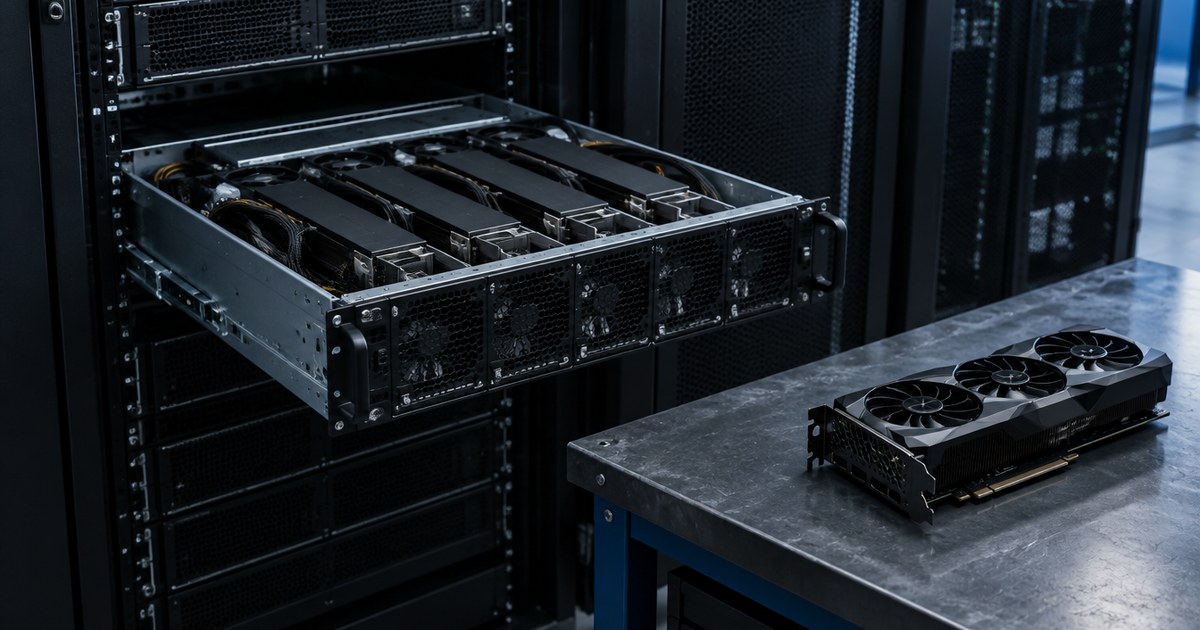
Should you self-host an LLM? What Revolut’s 10x cheaper switch means for a normal business
By Andrej Ruckij · November 4, 2026
TL;DR: Most businesses shouldn’t self-host, but almost all of them should start using open models. Revolut made self-hosted GLM, Z.ai’s open model, the default coding model for about 2,000 engineers. Self-hosting GLM-5.1 cost it about $0.30 per million tokens, roughly a tenth of Claude Code or Codex, and it now runs GLM-5.3 on 56 Nvidia B200 GPUs. I think that was a predictable move and more companies will make it: Gartner expects open-weight models to run 90% of enterprise agent workflow steps by 2030, at about a fifth to a sixth of frontier cost in practice. For a normal business, though, the saving comes from routing, not from buying GPUs. Send routine steps to a hosted open model (GLM-5.1 on OpenRouter starts at $0.90 in / $2.90 out per million tokens), keep a frontier model for the hard cases, and only look at self-hosting once you’re burning billions of tokens a month or your data can’t leave your own servers.
What Revolut actually did
David Abitbol, who leads ops and infrastructure at Revolut, described the switch at the AI Engineer conference in New York in October, as reported by The Register on November 3. The facts, all as the company tells them:
- Revolut went from Gemini (early 2025) to Claude Code (early 2026), then made self-hosted GLM-5.1 its default and later moved to GLM-5.3. Self-hosting GLM-5.1 cost about $0.30 per million tokens, about a tenth of Codex or Claude Code. Inference spend for AI coding fell by roughly 90% in under a year.
- What pushed them: “We were seeing engineers spend $1,000 a month, $10,000 a month with not so much ROI.”
- GLM-5.3 runs on 56 Nvidia B200 GPUs, the equivalent of seven eight-GPU DGX B200 boxes. GLM-5.1 has about 754 billion parameters (40 billion active per token) and needs about 380 GB of GPU memory for the weights alone, plus 6-26 GB per user for context.
- Most of the speed came from tuning, not extra GPUs: quantisation, splitting prefill and decode, and tuning context lengths. Abitbol’s line: “Long context is a scam.” About 256K tokens is what they need, even though they could serve 1M.
- The model is text-only, so it “isn’t ideal for things like UI work”, and a router sends vision requests to Gemini and other models. GLM hasn’t fully replaced GPT or Claude.
- He reports a 60% improvement in coding time and a 70% improvement in lead time across about 2,000 engineers, with the biggest gains in debugging and Jira and Confluence tickets rather than writing code. His explanation: “When you have unlimited tokens, you’re free to do that.”
That last point is the one I’d hold on to. A flat bill changed how people used the tool. The 60% and 70% figures are Revolut’s own and nobody has checked them.
Why I think this was predictable, and why more will follow
When I read the story my first reaction was that it’s very interesting, and also that it’s exactly what you’d expect. The pieces were already in place.
The gap is months, the price difference is 10x. Epoch AI’s May 2026 analysis found that since January 2026 the best open-weight models have trailed the best closed ones by about four months on its capability index. When the follower is four months behind and ten times cheaper, a company with a big enough bill will switch for the routine work.
Others had already done it. Airbnb built the customer service agent it launched in 2025 on Alibaba’s open Qwen model, and Brian Chesky described Qwen as “fast and cheap” (Semafor). The company uses thirteen AI models, ChatGPT among them, and relies heavily on Qwen (MarketScreener, October 2025). Cursor built its Composer 2 coding model on Moonshot’s open Kimi K2.5 and priced its standard tier at $0.50 in / $2.50 out per million tokens; it only disclosed the base after users spotted it, and co-founder Aman Sanger said “It was a miss to not mention the Kimi base in our blog from the start” (The Decoder). Decagon “achieved nearly 6× cost reduction per turn compared to closed models like GPT-5 mini” with a stack of fine-tuned open-source models, a figure from a case study published by its hosting vendor, Together AI.
The analysts and investors are lining up behind it. In a report covered by The Register, Gartner’s Mark Petty and Raymond Paquet argue that nine in ten agent workflow steps are routine and open models handle them “at parity for a quarter of the price of the cheapest closed model”. Against a frontier model on every step they put the saving at up to 20x, but say open models “can be more verbose and retry more often”, so the realistic figure is “closer to five or six times”. They expect open models to run 90% of operational agent steps by 2030. And on November 2 Trajectory raised $45M from Sequoia and Nvidia to let companies post-train open models on their own feedback; its customers include Harvey, Decagon and Nvidia (TechCrunch).
The useful question for a business that isn’t Revolut is how to get the saving without 56 B200s and an infrastructure team.
How much does an LLM cost? The three options side by side
You have three ways to run a model, and the middle one gets overlooked.
| Option | Example | Price (per 1M tokens, in / out) | What you need | Suits |
|---|---|---|---|---|
| Frontier API | Claude Opus 5.5 / Sonnet 5.5 / Haiku 5.5 | $4 / $20 · $2 / $10 · $0.10 / $0.50 | An API key | Hard reasoning, vision, anything where a mistake is expensive |
| Hosted open model | GLM-5.1 on OpenRouter | $0.90 / $2.90 (Chutes) to $1.40 / $4.40 (Z.ai, Nebius and others) | An API key; pick providers you trust | Routine, high-volume steps |
| Self-hosted open model | GLM on your own GPUs (Revolut) | ~$0.30, as Revolut reports it (hardware and staff costs not disclosed) | GPUs, serving software, people to run it | Billions of tokens a month, or data that can’t leave |
Sources: Claude pricing, OpenRouter GLM-5.1, The Register on Revolut. Haiku 5.5’s price applies to prompts up to 100K tokens; above that it’s $0.50 / $2.50.
A few things in that table matter more than they look:
- In my read, hosted open models already capture most of the saving. If you assume three input tokens for every output token and no caching (my assumption; your mix will differ), GLM-5.1 at the cheapest OpenRouter provider works out to about $1.40 per million against about $8 for Opus 5.5 and $4 for Sonnet 5.5. That’s roughly the 5-6x Gartner calls realistic, with no hardware.
- Provider prices vary a lot for the same model. On OpenRouter’s GLM-5.3 page most providers charge $1.40 / $4.40, but listings run from $0.07 input up to $2.80 / $8.80. DeepInfra’s own comparison (a vendor ranking itself cheapest, May 2026) found output speed ranging from 34 to 175 tokens per second across GLM-5.1 hosts, a 5x spread.
- Seats are a different comparison. A Claude Team premium seat costs $100-125 a month. Revolut’s 10x compares token prices, and it said some engineers had been spending $1,000-10,000 a month on metered tools; it didn’t compare against seats. If your team sits comfortably inside seat limits, the saving on paper is much smaller.
What hardware do you need to self-host an LLM?
It depends almost entirely on model size, and there’s a big jump between “one GPU” and “a rack”.
One GPU runs a mid-sized model. Epoch AI’s sizing from September 2025 puts the ceiling at about 28B parameters on an RTX 4090 and about 40B on an RTX 5090. That’s the class of Alibaba’s Qwen3.6-27B, released in April under the Apache 2.0 licence, which accepts images as well as text and which Qwen reports at 77.2% on SWE-bench Verified against 80.9% for Claude 4.5 Opus. Those are the vendor’s numbers, and Claude 4.5 Opus is no longer Anthropic’s newest model.
A large model needs a cluster. GLM’s 380 GB of weights alone means at least three 180 GB B200s or about five 80 GB H100s (380 / 80 = 4.75), and the per-user context needs more on top. That’s my arithmetic from Revolut’s figures.
Rental prices on RunPod, per GPU per hour, community cloud / secure cloud:
| GPU | Memory | $/hour | Rough monthly, running 24/7 (secure) |
|---|---|---|---|
| RTX 4090 | 24 GB | $0.34 / $0.89 | ~$650 |
| RTX 5090 | 32 GB | $0.69 / $1.19 | ~$870 |
| H100 SXM | 80 GB | $2.69 / $3.99 | ~$2,900 |
| B200 | 180 GB | $5.98 / $7.99 | ~$5,830 |
So a four-B200 or eight-H100 setup for a GLM-class model rents for about $23,000 a month before anyone touches it. For scale: renting Revolut’s 56 B200s at RunPod’s community rate would come to about $244,000 a month, or about $120 per engineer across 2,000 engineers. Revolut hasn’t said whether it owns or rents its GPUs or what they cost, so treat that only as a sense of proportion.
The serving software is free. vLLM, Apache 2.0, gives you an OpenAI-compatible API server, so most tools that talk to OpenAI can be pointed at your own model.
Is open source LLM cost really a tenth? The hidden costs
The headline price assumes a busy GPU and a model that gets it right first time. Neither is free.
Utilisation. A rented GPU costs the same idle or busy. Findstack’s October 2026 break-even analysis assumed one A100 at $1.19 an hour serving a 70B model at about 20 tokens a second. At 100% use, that’s $16.53 per million tokens, about 52 times DeepInfra’s hosted price for the same model: “Against a hosted version of the same model, self-hosting is 52× more expensive and there is no break-even at any volume.” It says typical self-hosters reach 5-15% utilisation. Revolut gets around this with 2,000 engineers keeping the cluster busy; a 30-person company won’t.
Retries and verbosity. Gartner’s own caveat: open models talk more and retry more, which is why 20x becomes 5-6x.
People. Revolut’s results came from tuning work by an infrastructure team. Findstack’s analysis doesn’t include staff costs at all, and I found no published figure I’d trust for what running a production model costs in people-time at a small company.
Licences. Read them per model. GLM-5.1 is MIT-licensed, per its Hugging Face model card. Z.ai released GLM-5.3’s weights on August 28 under what Runtime Wire calls a “broad commercial license”; it doesn’t quote the terms. Qwen3.6-27B is Apache 2.0. Cursor’s Kimi licence came through a commercial deal with its inference partner Fireworks.
Chinese models and compliance. Many of the best open models come from Chinese labs, and that has a cost in scrutiny. In April 2026 the chairs of the House China and Homeland Security committees sent letters to Airbnb and to Cursor’s parent Anysphere asking about their use of Chinese models; Chairman Moolenaar said the models “are trained by China’s censorship regime” (Semafor). A bipartisan bill to ban such tools from US federal agencies was introduced in June 2025 (ExecutiveGov); it covers executive agencies, not private firms, and the coverage I found doesn’t show it passing. Abitbol’s position is that the concern is mostly about reaching the models through APIs run out of China: “When run on-prem or on regional cloud resources, there’s really nothing to worry about.” If you sell to governments or regulated buyers, ask them before you pick a model, not after.
Where open models still fail
Vision and UI. Revolut routes vision away from GLM because it’s text-only. Some open models do take images, Qwen3.6 among them, so check per model.
Long, multi-step agent work. The AgentFloor benchmark (May 2026) tested 16 open models up to 32B against GPT-5 on a ladder of tool-use tasks. Small open models handled short, structured tool calls, and the best one roughly matched GPT-5 overall, but frontier kept the edge on long-horizon planning. The authors’ advice is the routing one: routine actions to small open models, deep planning to frontier. A June 2026 preprint found several open models stopped calling tools entirely when tool calling and strict JSON output were switched on together.
Small models on a laptop, doing real coding. The most sobering thing I read was an October 2026 study by an independent researcher who delegated TypeScript tasks from Claude Code to local 30B-class models on a 32 GB laptop. Claude alone verified 45 out of 45 tasks, though that includes reruns of sessions a spend limit blocked before any model call; counted as failures, it’s 37 of 45. Delegating to Nemotron verified 12 of 45 (8 of 45 on the same basis), and a separate Qwen3-Coder run verified 0 of 45, with no direct Claude arm to compare against. Delegation didn’t lower the frontier cost per verified success in either study that compared it. The author still ends “more optimistic about open-weight AI than when I began”, but the gap between running a model and getting work done is the point.
Should you self-host an LLM for coding?
For most teams, not yet. The evidence splits by size of model and size of team.
Revolut’s case works because GLM is a 754B model on a serious cluster with an infrastructure team behind it. At the small end, the r/LocalLLM thread “Qwen3.6:27b is the first local model that actually holds up against Claude Code for me” (425 points, mirrored snapshot) is a fair picture of where single-GPU coding is. The poster says local “actually feels good and usable for real work”, but the hard multi-file architectural work still goes to Claude and setting up the agent “took real fine tuning”. In the comments, one person reports about six hours for Qwen against 20 minutes for Opus on a multi-file test-fixing task; others report tool-calling loops and slowness. Some on an RTX 5090 say it matched Opus for their work.
What does the counter-evidence say?
Enterprise share went down, not up. Menlo Ventures’ survey of about 500 US enterprise decision-makers (December 2025) found open-source adoption “fell nearly 50%, from 19% to 11%”, with organisations “remaining cautious toward Chinese models despite rapid performance gains.” Its mid-2025 update blamed a performance gap, deployment complexity and “enterprise reluctance to use APIs from Chinese companies.” That data is nearly a year old and predates GLM-5 and Qwen3.6; I found no 2026 update from Menlo. It’s still the strongest number against my read, and I’d watch whether the next edition reverses it.
I found no documented case of a company moving back from self-hosted open models to a frontier API. That could mean it doesn’t happen, or that nobody writes those posts.
How to decide
The move most businesses can make this month is routing: a cheap model by default, a frontier model on exception. Two tools do it without building anything:
- OpenRouter: one API for hundreds of models, billed at each provider’s list price plus a 5.5% platform fee on credits (8% on Business). Bring-your-own-key usage is free up to $25,000 a month of list-price inference, then 5%. Its auto router “adds no fee”. EU-only routing comes with the Business and Enterprise plans.
- LiteLLM: an open-source gateway you run yourself, “a single, unified interface to call 100+ LLM providers”, with retries, fallbacks, per-project spend tracking and auto-routing. SSO and support sit in a paid enterprise tier.
Then pick your lane with these thresholds. The token figures are my arithmetic from the prices above (3:1 input to output, no caching, GPUs fully busy), so treat them as orders of magnitude:
- Stay on frontier APIs only if your AI bill is a few hundred dollars a month, or every step is hard reasoning, vision or customer-facing judgement. Routing won’t pay for the setup time.
- Add a hosted open model behind a router if a meaningful share of your calls are repetitive: classification, extraction, summaries, ticket triage, first-pass code. In my view this is the right lane for most small and mid-sized businesses, and it’s where I’d expect most of the 5-6x to show up.
- Consider self-hosting a single-GPU model (Qwen3.6-27B class, roughly $650-2,900 a month rented) if your data can’t leave your servers and the tasks are short and well-defined. Don’t expect it to replace Claude Code on multi-file work.
- Consider self-hosting a large model only if you’d keep a ~$23,000-a-month cluster busy. On the same blended basis as above (3:1 input to output, list prices), that’s around 3 billion tokens a month to beat Opus 5.5 at $8 per million, about 6 billion against Sonnet 5.5 at $4, and about 16 billion against GLM-5.1 at the cheapest OpenRouter host, $1.40. One engineer spending $1,000 a month at Opus prices uses about 125 million tokens, so you’d need roughly two dozen heavy users before the hardware pays, plus the people to run it.
- Data sensitivity overrides cost. If data must stay in a region, a regional host (OpenRouter’s EU routing, or your cloud’s managed models) is the middle step before your own GPUs.
Who this is for
For: founders, CTOs and ops leads paying for AI APIs or coding seats, especially with agents or pipelines that make many calls per task. Not for: teams whose usage fits inside a few chat subscriptions, or anyone whose buyers ban Chinese-origin models, unless they stick to Western open models or frontier APIs.
What I’d do this week
Export a week of your API logs (the usage page of your provider’s console works). Pull 50 real requests from your most frequent task, run them through GLM-5.1 or Qwen on OpenRouter with the same prompts, and have someone grade the outputs blind against your current model’s. If 45 or more are as good (my rule of thumb: 90%), put that task behind a router with your current model as fallback, and compare the bills after a month. It’s about an afternoon of work, and for your own task I’d trust it over a public benchmark.
If you’re weighing a bigger build decision, should you build or buy software now that AI can build a tool in two hours? covers the other side of cheap AI, and how to create skills in Gemini shows how to write instructions once and reuse them across models, which makes switching models cheaper.
Sources
- The Register: Revolut slashes AI coding costs 10x by going self-hosted (Nov 3, 2026)
- The Register: Gartner says open models can do 90% of agentic work (Nov 3, 2026)
- Epoch AI: open-weight models lag closed models by about four months (May 29, 2026)
- Epoch AI: the best model you can run on a single consumer GPU (Sep 2025)
- MarketScreener: Airbnb opts for Chinese AI model over ChatGPT (Oct 2025)
- Semafor: House committees probe Cursor parent, Airbnb over Chinese AI (Apr 29, 2026)
- The Decoder: Cursor built Composer 2 on Kimi K2.5 (Mar 2026)
- Together AI: Decagon customer story (vendor)
- TechCrunch: Trajectory raises $45M (Nov 2, 2026)
- Claude: pricing
- OpenRouter: GLM-5.1 providers and prices
- OpenRouter: GLM-5.3 providers and prices
- OpenRouter: pricing and fees
- DeepInfra: GLM-5.1 pricing and provider comparison (vendor, May 2026)
- Runtime Wire: Z.ai opens GLM-5.3 weights (Aug 28, 2026)
- Hugging Face: GLM-5.1 model card
- Hugging Face: Qwen3.6-27B model card
- RunPod: GPU pricing
- vLLM on GitHub
- LiteLLM on GitHub
- Findstack: self-hosted LLM vs API, the break-even calculated (Oct 2026)
- ExecutiveGov: bipartisan No Adversarial AI Act (Jun 2025)
- arXiv: AgentFloor, how far up the tool-use ladder small open models go (May 2026)
- arXiv: Constraint tax in open-weight LLMs, tool-calling suppression (Jun 2026)
- arXiv: Can small open-weight models get real coding work done? (Oct 2026)
- r/LocalLLM: Qwen3.6:27b holds up against Claude Code (mirrored snapshot, May 2026)
- Menlo Ventures: 2025 State of Generative AI press release (Dec 9, 2025)
- Menlo Ventures: 2025 mid-year LLM market update (Jul 31, 2025)
- Primores: should you build or buy software now that AI can build a tool in two hours?
- Primores: how to create skills in Gemini
- Image: generated for this article.
More of this every day on the channel: https://t.me/aidaily_business