AI acquisitions and funding in late 2026, and what they tell a business
Every AI-related acquisition and funding round I could verify from October 28 to November 9, 2026, sorted by layer, with totals with and without the two mega-deals. Then what the money says for marketers, sales leaders, online stores and local service businesses: who is buying customer-service AI, why agent payment rails are funded while agent orders are near zero, and which vertical agents are getting paid.
What do the latest AI acquisitions and funding rounds say about where business AI is going?
By Andrej Ruckij · November 6, 2026, updated November 9 with the deals since
TL;DR: From October 28 to November 9, 2026, I counted about $177B in AI-related deals. I wouldn’t read much into that number. Three quarters of it is two deals, Marvell buying Lumentum with stock and DoorDash buying Instacart, and take those out and it’s about $45B. The part I’d watch if you run a business is smaller. Platforms keep buying AI customer-service and sales tools instead of building them, and now Dialpad is merging with Ada. Investors are funding the checkout plumbing for AI shopping agents, even though Uber counted only 4 agent-booked rides in its busiest October week. And the vertical AI companies raising money do boring, expensive jobs, like insurance underwriting or answering a plumber’s phone. This is for people running a business, not an investment guide.
The deals, October 28 to November 9, 2026
Kind: A = acquisition (announced; almost none have closed), R = equity round, N = notes or financing. Amounts in US dollars. I first published this on November 6. The Ada row and the November 6 rows were added on November 9.
| Date | Company | Buyer / investors | Amount | Kind | Layer |
|---|---|---|---|---|---|
| Oct 28 | Broccoli AI | Khosla (lead), YC, Operator Partners | $30M Series B | R | Sales and customer service (home services) |
| Oct 28 | Fragment | 8VC, General Catalyst, A* | $56M seed and Series A combined | R | Vertical agents (procurement) |
| Oct 29 | ADT | Thrive Holdings, Apollo financing | $15.3B enterprise value ($7.6B equity) | A | Vertical agents / AI roll-up |
| Oct 29 | Instacart | DoorDash | ~$17B | A | Consumer, commerce and retail media |
| Oct 29 | Wabi | IVP (lead), a16z, Forerunner | $55M at $1.25B | R | Consumer |
| Oct 29 | Daily (Pipecat) | Deepgram | Not disclosed | A | Agent tooling (voice) |
| ~Oct 29 | Dream | a16z (lead), SV Angel, XYZ | $17M seed | R | Vertical agents (building design) |
| Nov 1 | Perion | Affle | ~$420M cash | A | Marketing (adtech, retail media, CTV) |
| Nov 2 | Lumentum | Marvell | $115B enterprise value, all stock | A | Chips and networking |
| Nov 2 | Cresta | Salesforce | $2.7B, reported (Salesforce did not disclose a price) | A | Sales and customer service |
| Nov 2 | Flamel.ai | Yext | Not disclosed (completion of a deal announced September 30) | A | Marketing (local paid media) |
| Nov 2 | Trajectory | Sequoia (lead), Nvidia, Bessemer, BCV | $45M Series A at $300M | R | Models and training |
| Nov 2 | 42AI | Founders and Infinity Group, over three years | $62.5M seed | R | Models |
| Nov 3 | Fal | Bessemer (lead), Nvidia, T. Rowe Price | $1.3B Series F at $16B | R | Infrastructure (image and video inference) |
| Nov 3 | Fiddler AI and Dreadnode | CrowdStrike | ~$495M, reported by WSJ | A | Agent tooling (AI security) |
| Nov 3 | Tigris Data | Dropbox | ~$350M cash | A | Agent tooling (storage) |
| Nov 4 | Conductor | Meta | Not disclosed | A | Agent tooling (coding agents) |
| Nov 4 | Pliant | Seaya Nova, Speedinvest (leads) | $80M Series C | R | Agent tooling (B2B payments) |
| Nov 4 | Contlo | QuestionPro | Not disclosed | A | Marketing (ecommerce messaging) |
| Nov 4 | Ada | Dialpad (all-share merger) | Not disclosed; about C$600M (roughly US$430M) reported by The Globe and Mail | A | Sales and customer service |
| Nov 4 | Nooks | General Catalyst Customer Value Fund | $500M financing commitment, no equity | N | Sales |
| Nov 5 | Level AI | Five9 | ~$325M cash | A | Sales and customer service |
| Nov 5 | firmly | Squarepoint (lead), J.P. Morgan Payments, Mastercard, Samsung NEXT | $15M Series A | R | Agent tooling (agent checkout) |
| Nov 5 | Kalepa | Updata Partners (lead), IA Ventures, Inspired Capital | $75M Series B at $470M | R | Vertical agents (insurance) |
| Nov 5 | Echodyne | Shield AI | $5.3B, including a $500M earn-out | A | Defense / physical AI |
| ~Nov 5 | Future Secure AI | Square Peg, Yarra, Firetrail | $80M convertible notes at $1.2B | N | Vertical agents (banking, consulting, law) |
| Nov 6 | OpenAI | Not named | $11B so far, reported by Bloomberg, of a round that could reach about $20B at $1.25T | R | Models and training |
| Nov 6 | Thinking Machines Lab | Accel (lead) | $5B at $40B pre-money, reported, not confirmed | R | Models and training |
| Nov 6 | Zipline | Paradigm, WCM, Layer Global (leads), Uber, Fidelity, J.P. Morgan, Salesforce Ventures | $1.5B at $21.5B | R | Robotics and physical AI (drone delivery) |
| Nov 6 | Crusoe’s Wyoming data-center project | Not disclosed; Google plans to invest $17B in the campus | A | Chips, compute, infrastructure | |
| Nov 6 | Aventus | SupportNinja | Not disclosed | A | Sales and customer service (managed AI support) |
Not in the table: Palo Alto Networks is reported to be in talks to buy Clutch Security for about $500M, and talks are not a deal. AMD bought Taalas in August without naming a price; AMD has now put a price on that deal, about $2.9B, in its quarterly filing. Neither is counted below.
Where the money went
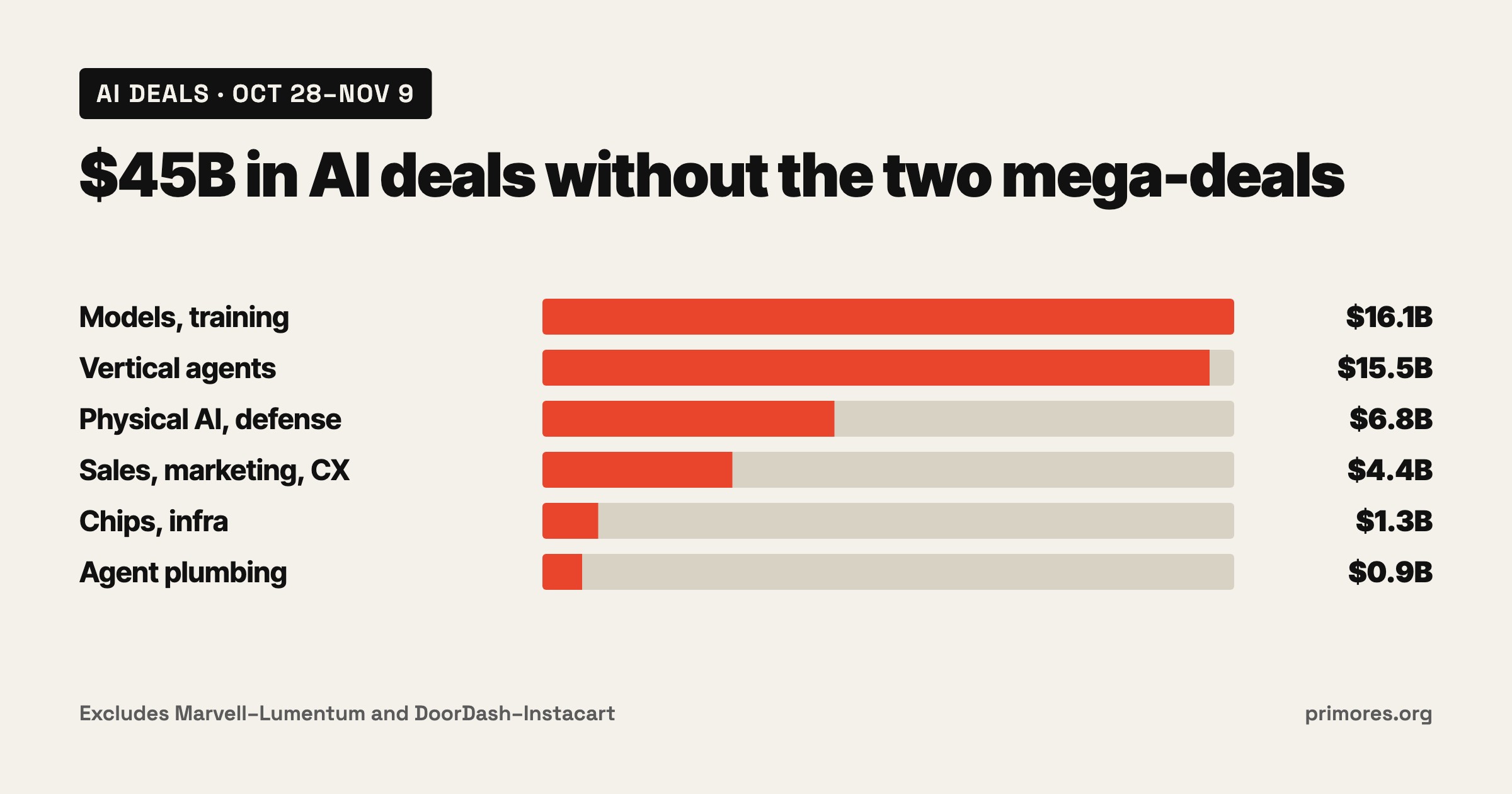
I only count amounts that were disclosed or reported. Shield AI’s $2.5B raise isn’t added on top, because it pays for Echodyne. And these totals include AI-adjacent targets: Instacart, ADT, Echodyne and Perion aren’t AI companies themselves, they’re bought or pitched on an AI strategy. The “two mega-deals” in the right-hand column are Marvell-Lumentum and DoorDash-Instacart.
| Layer | Total | Without the two mega-deals |
|---|---|---|
| Chips, compute, infrastructure | $116.3B | $1.3B |
| Models and training | $16.11B | $16.11B |
| Tools AI agents run on (payments, security, storage, checkout, coding) | $0.94B | $0.94B |
| Vertical agents and applications | $15.53B | $15.53B ($0.23B without ADT) |
| Marketing, sales and customer service | $4.41B | $4.41B |
| Consumer | $17.06B | $0.06B |
| Defense, robotics and physical AI | $6.8B | $6.8B |
| Total | ~$177.1B | ~$45.1B |
So here’s how I read the table. Marvell-Lumentum and DoorDash-Instacart together are about three quarters of everything, and neither changes what a normal business buys next quarter. Take them out and the next biggest is Thrive buying ADT, a $15.3B figure that includes debt. After that come OpenAI’s reported round and Shield AI’s purchase of Echodyne.
Until November 6 this list was nearly all acquisitions, and rounds and notes were a rounding error at about $2.3B. Then OpenAI, Thinking Machines and Zipline all raised on November 6, and rounds and notes jumped to about $19.8B. Two of those three rounds are only reported, though.
For scale, Crunchbase puts Q3 2026 AI venture at $102B, which is roughly $14B for any 13 days. So these two weeks run at about 1.4 times that pace, almost entirely because of two reported frontier-lab rounds. It’s a rough comparison, since Crunchbase counts startup rounds and my list also includes notes.
The OpenAI round is interesting on its own. Bloomberg’s sources say OpenAI has $11B so far, in a round that could reach about $20B at $1.25T. Back in September, Bloomberg reported it wanted $30B. So far it’s smaller than that plan, and it’s happening the same week the market dumped AI stocks.
That selloff matters as context. On November 5 the Nasdaq was down about 5.2% at midday and the chip index was heading for its worst day since March 2020, as investors read the US midterm results as an early limit on data-center building (Fortune).
The deals that actually change what you buy are the small ones in the marketing, sales and agent rows, so that’s where the rest of this goes.
Why are big companies buying AI customer-service tools instead of building them?
In under two weeks, six companies announced or completed deals for AI customer-service, voice or marketing tools to add to what they already sell. Salesforce is buying Cresta, which does voice agents and live coaching for reps, for a reported $2.7B. Five9, a contact-center platform, is paying about $325M in cash for Level AI, which runs its own models and which Five9 says has “lower costs and latencies than frontier models”. Deepgram bought Daily, the company behind the Pipecat voice-agent framework. QuestionPro bought Contlo for email, SMS and WhatsApp automation. Yext completed its purchase of Flamel.ai for local paid media. And Dialpad, which runs calls and contact centers, is merging with Ada, which makes AI agents for customer support. The Globe and Mail put Ada at about C$600M, roughly a third of the US$1.2B it was valued at in 2021 (BetaKit).
There’s a services version of the same move too. SupportNinja, an outsourcing company, bought Aventus. According to the announcement, Aventus has worked with 100+ ecommerce brands, either managing the AI inside their Gorgias or Zendesk setup or running their whole support operation with human agents. My read is that some brands want someone to operate their support AI for them. That’s one deal, though, so I wouldn’t call it a trend yet.
I think buying is faster than building when the customer already expects the feature. For you, the voice agent or AI messaging tool you’re evaluating could become a module of your CRM or contact-center vendor within a year or two. That changes how you sign. Ask your current vendor what is on its roadmap before you commit to a point tool, and put a change-of-control clause in any multi-year contract with a startup. If you run an agency that sells AI voice setup, I’d expect more of that work to become configuring Salesforce or Five9 instead of wiring up a standalone tool.
This can go wrong for you, though. Acquired products often stall for a year while they get integrated, and none of Cresta, Level AI or Ada has closed yet. Ada’s reported price, about a third of its 2021 valuation and paid in shares, also shows that being bought isn’t always a win for the startup. Meanwhile independent tools and vertical players like Broccoli may ship faster, so waiting for your vendor can mean a year without the savings.
Why is money going into AI agent payments when almost nobody uses agents to buy?
A group of deals funds the rails for AI agents that buy and pay. Pliant raised $80M to open its B2B payments platform to AI agents. firmly raised $15M with Mastercard and J.P. Morgan Payments as investors. CrowdStrike is buying two AI security companies for a reported $495M. Dropbox is buying Tigris and launched a product called DBX Agent Cloud (filing).
The demand side looks very different. Uber says AI agents placed 4 rides and about 500 Eats orders in its busiest October week, out of roughly 320 million trips and orders, and its CEO called it “very, very early and very limited traction” (TechCrunch). Uber is a weak test, though. Its app already books a ride quickly, and I think payment rails usually get built before the volume shows up. Agents may show up first where the human process is slow, in procurement, B2B reorders and travel, and Pliant earns card and spend-management revenue in the meantime, so its rails don’t depend on agent volume.
For a store or booking business, that says: don’t rebuild checkout for AI agents this year. Do the cheap readiness work. Keep product and price feeds clean, check that the product markup on each page shows the same price and stock as your feed, and switch on whatever agent connector your commerce or payment platform ships at no extra cost. Pay for agent security only if you already have agents touching credentials or payments, because that is the risk CrowdStrike is paying for, and the one Palo Alto is reportedly in talks over.
Which AI agents are getting funded, and do they make money?
The vertical rounds share a pattern: each one takes over a repetitive, costly judgment call in one industry. Kalepa raised $75M for insurance underwriting and says it has been cash-flow positive for more than two years. Fragment raised $56M for purchasing and payment exceptions. Broccoli raised $30M to answer phones and book jobs for plumbers and HVAC firms, and says more than 1,500 businesses use it. Future Secure AI raised $80M in notes for supervised agent teams in banking, consulting and law. Dream raised $17M for building design.
Then there is the extreme version. Thrive Holdings is taking ADT private for $15.3B, and the filing says ADT “will form the foundation of Thrive Holdings’ smart home security business”. The release doesn’t mention AI. Reading it as buying a whole service company to run with AI is the market’s view of Thrive, not something the filing states.
What this means in practice: look for the job where someone makes the same call many times a day, such as a missed call, a mismatched invoice or a quote, and buy a tool built for that job rather than a general agent builder.
I’d be careful with these numbers, because most of them come from the companies themselves. Broccoli’s customer count and Future Secure’s revenue projection are self-reported, and valuations run ahead of revenue. ADT is a leveraged private-equity deal with an AI story attached, which proves nothing yet about AI improving margins.
What does the money say about AI in marketing?
The marketing deals cluster around local paid media, retail media and messaging, and they arrive through platforms. Yext’s Flamel uses agents to localize one campaign across hundreds of franchise locations (PPC Land). Affle is paying about $420M for Perion, whose business includes retail media and connected TV. DoorDash is buying Instacart, which has one of the largest US retail media networks, in a deal expected to close at the end of 2027 or in the first half of 2028 (ITV). And Nooks got a $500M commitment “to finance the company’s sales and marketing push”, with no equity taken.
For a multi-location brand, “set the campaign once and let agents localize it” is likely to show up inside the listings or local SEO tools you already pay for. That makes the human work the message and the offer per location, since execution is being automated. If you sell through grocery, you’ll have fewer and bigger retail media networks to negotiate with, and that could just as easily mean higher fees as better results. I wouldn’t treat any of this as proof the tools work, either. Flamel’s and Contlo’s prices weren’t disclosed, and DoorDash-Instacart is a delivery deal first.
Is the AI infrastructure money a bubble?
The biggest money of these two weeks is also the most fragile. Marvell’s $115B for Lumentum is all stock, so no cash actually changes hands. Fal is now valued at $16B after raising $1.3B, which is double what it was worth in April (SiliconANGLE). Anthropic’s updated filing lists $895.4B in cloud and data-center commitments. And then on November 5 AI stocks sold off, with AMD down about 14% and CoreWeave about 9% (Fortune). A day later Crusoe confirmed it sold its unfinished Wyoming data-center project to Google, and TechCrunch says Google reportedly had concerns about cost and timeline under Crusoe (TechCrunch). So this one ended up with the hyperscaler, not the independent builder.
Outside data centers, investors still pay up for big AI bets. Thinking Machines is reportedly raising $5B at a $40B valuation before the new money, to sell Tinker, which lets companies train models on their own data. Zipline raised $1.5B at $21.5B for drone delivery, with Walmart evaluating 300 more sites and Uber aiming for a million Zipline deliveries a day by 2029, though Tech Funding News points out that the FAA and local authorities make that timeline uncertain (Tech Funding News).
I don’t know whether it’s a bubble. One selloff driven by election results doesn’t say much about demand for inference, and a business doesn’t need the answer anyway. What matters for you is that image, video and voice generation is heavily funded, and with that much money chasing the same customers, my guess is the cost of AI content keeps falling. Avoid long prepaid commitments to one model or inference vendor, and keep your prompts and workflow steps in a document you own, not only inside one vendor’s tool, so switching takes a day instead of a project.
What I’d do this week
If I were in one of these seats, this is what I’d do.
Marketer at a multi-location brand. I’d email the listings or local SEO vendor and ask one question: will it localize paid campaigns per location in 2027, and at what price. Keep the answer next to your agency contract renewal date. 15 minutes.
Sales or customer-service leader. List every AI point tool you pay for or are trialing, with its contract end date. For each, ask your CRM or contact-center vendor whether the same feature is on its roadmap. Before signing anything multi-year with a startup, ask legal to add a change-of-control clause. An hour.
Ecommerce owner. Open your platform’s app store or payments settings and check whether it already offers an AI agent or agentic checkout connector at no extra cost. If it does, switch it on and stop there. If it doesn’t, spend the time fixing missing prices, sizes and stock in your product feed instead. Uber is a single company, but until another platform reports real agent order volume, I wouldn’t pay a separate vendor for agent checkout.
Local service business. Count missed calls for one week from your phone system’s call log. If you’re losing several jobs a week to unanswered calls, trial a vertical answering and booking tool for your trade, the category Broccoli is in, before you look at general AI assistants. If you’re not, skip it.
Who this doesn’t apply to: if you’re deciding whether to buy chip stocks or AI startups, this isn’t the piece for you.
What the data can’t show
- Undisclosed prices. Meta-Conductor, QuestionPro-Contlo, Deepgram-Daily, Yext-Flamel, SupportNinja-Aventus and Google-Crusoe have no public price, and Ada’s is a press figure, so the marketing, customer-service and infrastructure totals are probably understated.
- Reported, not confirmed. Cresta’s $2.7B and CrowdStrike’s $495M come from people familiar with the deals and from WSJ. OpenAI’s $11B and Thinking Machines’ $5B are from Bloomberg’s and Business Insider’s sources, and neither company confirmed. Treat all four as approximate.
- Announced, not closed. Apart from Yext-Flamel, which completed, the acquisitions here are announced but not closed, from Ada (expected around November 12) to Instacart (late 2027 or the first half of 2028).
- Enterprise value isn’t cash. ADT’s $15.3B includes debt, Marvell’s $115B is stock, and Shield AI’s $5.3B includes an earn-out.
- Unusual financings. 42AI’s $62.5M is mostly founder and insider money over three years, Nooks’ $500M is a revenue-based commitment, and Future Secure AI raised convertible notes.
- Coverage gaps. Crunchbase’s roundup for the week ending November 6 wasn’t out when I first checked, so some mid-size rounds may be missing, and deals outside the US are under-sampled.
- One demand data point. Uber’s numbers are the only hard figures on agent usage, from one company with a fast app.
Related: our wiki on automation/agentic-commerce and glossary/agent-payment-protocols.
Sources
- Fortune: Broccoli AI funding
- Axios: Fragment launches with $56M
- Ventureburn: Fragment raises $56M
- SEC: Thrive Holdings and ADT press release
- ITV: DoorDash to buy Instacart
- Let’s Data Science: Wabi raises $55M
- The Next Web: Deepgram acquires Daily
- The Next Web: Dream raises $17M
- The Week: Affle to acquire Perion
- SEC: Perion filing
- Light Reading: Marvell strikes $115B deal for Lumentum
- The Next Web: Marvell-Lumentum all-stock deal
- Dealroom: Salesforce to buy Cresta
- PPC Land: Yext acquires Flamel.ai
- TechCrunch: Trajectory
- TechCrunch: 42AI comes out of stealth
- SiliconANGLE: Fal raises $1.3B
- SecurityWeek: CrowdStrike buys Fiddler and Dreadnode
- The Next Web: CrowdStrike acquisitions
- SEC: Dropbox filing on Tigris
- TechCrunch: Meta acquires Conductor
- Pliant: $80M Series C
- The Next Web: Pliant opens payments to AI agents
- GlobeNewswire: QuestionPro acquires Contlo
- Investing.com: Nooks secures $500M
- SEC: Five9 acquires Level AI
- GlobeNewswire: firmly raises $15M
- Axios: firmly Series A
- AlleyWatch: Kalepa raises $75M
- Shield AI: Echodyne acquisition
- Startup Daily: Future Secure AI raises $80M
- Globes: Palo Alto Networks in talks for Clutch
- SEC: AMD quarterly filing
- Crunchbase News: Q3 2026 global startup funding
- Fortune: tech selloff, November 5
- TechCrunch: almost no one uses AI agents to book Uber
- DatacenterDynamics: Anthropic S-1 update
- CMSWire: Dialpad merges with Ada
- BetaKit: Ada to merge with Dialpad
- MarTech Series: SupportNinja acquires Aventus
- TechCrunch: OpenAI reportedly raises $11B at $1.25T
- Tech Funding News: Thinking Machines Lab $5B round
- Tech Funding News: Zipline raises $1.5B
- TechCrunch: Crusoe sells Wyoming project to Google