How to Block AI Agents From Your Website (and Should You?)
Most stores shouldn't: allow ChatGPT's signed agent and block only where fraud, scarce stock or regulation demand it, with each vendor's setting.
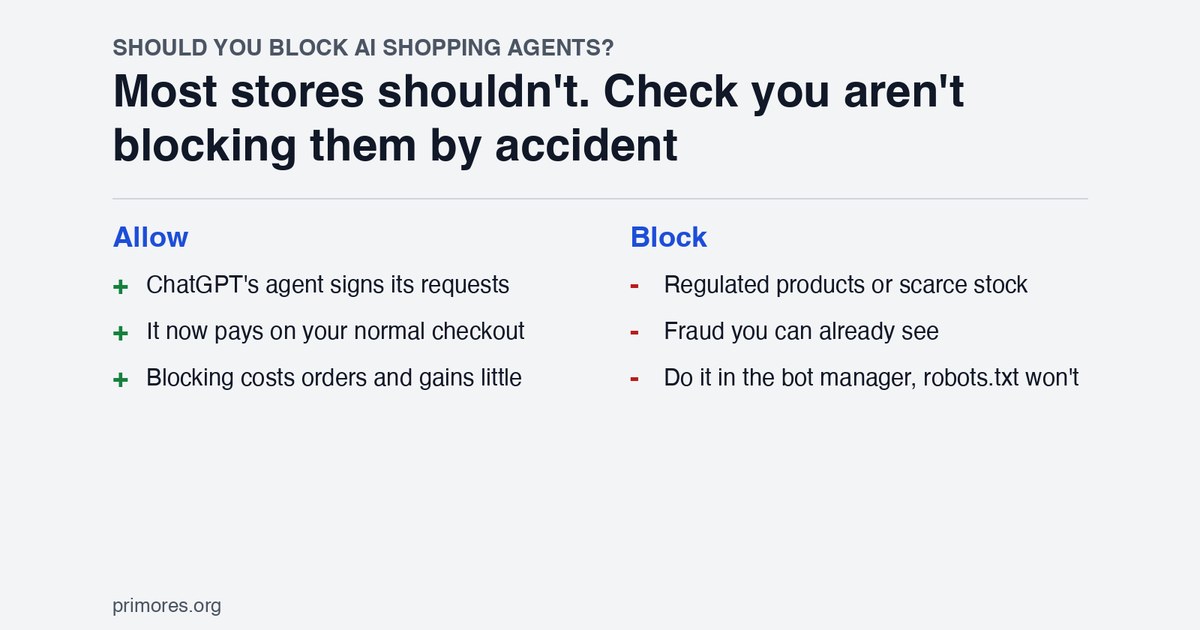
Should you block AI shopping agents from your store?
By Andrej Ruckij · November 16, 2026 · OpenAI’s developer docs reread today
TL;DR: For most online stores, no. Let ChatGPT’s agent through. It signs its requests, it now pays with ChatGPT Wallet on your normal checkout, and blocking it gains you next to nothing while risking the few orders it brings. Block, or gate checkout, only if you have a concrete reason: regulated sales, scarce stock that bots resell, a marketplace that sells API access, or fraud you can already see. If agents mostly add server load and skew your analytics, limiting them is fair too. If you do block, robots.txt won’t do it. It has to happen in your bot manager (Cloudflare, Akamai, HUMAN, Vercel), and the settings are below. Agent orders are tiny today, so the real job this week is checking you aren’t blocking agents by accident.
Who this is for
This is for stores selling physical products online, especially to US shoppers, because that’s where ChatGPT Wallet works right now. It also applies to travel and booking sites, which have their own reasons to say no.
It isn’t for a content site worried about AI companies scraping and training on its articles. That’s a different decision about crawlers, and I’ve covered it in should you block or allow AI crawlers. If you need the background on how shopping agents find and buy products in the first place, start with how AI shopping agents work. This piece is only about the agent that shows up at your store to buy something for someone.
What changed this week: ChatGPT Wallet for merchants
On November 13 OpenAI launched ChatGPT Wallet. OpenAI’s own announcement page refused to load for me (HTTP 403), so the launch details here come from trade press, and the merchant details from OpenAI’s developer docs, which did load.
Per PPC Land and The Paypers, it’s for ChatGPT Pro subscribers aged 18 or older in the US with eligible US-issued cards. It runs inside OpenAI’s “dots” agents and was built with American Express, Mastercard and Visa. Each purchase needs a face or fingerprint check. After that the card network issues stand-in credentials, so the agent and the store never see the real card number. The Paypers says OpenAI expects people to eventually “set parameters such as spending limits, purchase categories, or time periods” and let the agent buy on its own. That part isn’t live. Neither source mentions fees.
What matters for a store is in OpenAI’s docs. “ChatGPT Wallet works out of the box with existing checkout pages and payment forms.” You get “a network token instead” of the card number, and you use the Payment Account Reference to tie it to the underlying account. And the line every store owner should read twice: “Your business handles the order, fulfillment, customer support, and fraud decisions.”
So there’s nothing to integrate to get paid. The one thing OpenAI asks is that your security settings don’t block its cloud browser. Its Agent Access page exists to “help prevent unintended blocks of verified ChatGPT browser visits,” and PPC Land quotes OpenAI’s playbook: “websites need to ensure agents are not inadvertently blocked.” Whether you let that browser in is the whole decision.
Should I allow AI shopping agents on my store? The case for allowing
The buyer is real and the money arrives on your checkout. A Wallet purchase is a person who asked an agent to buy your product and approved it with their face. It runs through your own checkout and your own payment processor, and you keep the customer record.
Accidental blocking already happens. Blend Commerce, a Shopify agency, tested 200 UK and US retailers between 8 and 15 September 2026 with an unmodified Chromium browser from residential connections, and “29 of the 200 wouldn’t let us in at all, even when we tried TWICE.” Of the 24 refusers whose robots.txt they could read, all 24 allowed the search crawlers from ChatGPT, Perplexity and Claude. So robots.txt allowed AI, and the security layer still blocked it. Blend’s view is that security or infrastructure teams set these blocks and “nobody thought to ask the person who owns revenue.” It’s a small test from a company with a stake. Blend discloses “we would have a vested interest,” and PPC Land points out it used an unrecognised browser. So it shows how stores treat unfamiliar automation. How they treat ChatGPT’s agent, which may be on allow lists, wasn’t measured.
ChatGPT’s agent is the one that identifies itself. It signs its requests with Web Bot Auth, so you can let it in without opening the door to everything else. Arkose Labs, which sells bot detection, found ChatGPT agent signed 78.4% of its sessions, “the only agent that signed at scale” (vendor-reported). If you’re going to make one exception, it’s the easiest one to make safely.
AI-referred shoppers are worth having. Adobe says AI traffic to US retail sites grew 71% year on year in September 2026. It also converted 90% better than other traffic (vendor-reported, and Adobe gives 83% higher revenue per visit too). Careful with this one. Adobe counts people clicking a link out of an AI answer, which is discovery. It tells you AI matters to your sales, and says nothing about whether agents check out.
Should I block AI agents? The case for blocking
The orders are tiny. This is the strongest argument, and it cuts both ways. On their Q3 calls, per Fortune, Uber’s agents booked four rides and 500 Eats deliveries in Halloween week against roughly 320 million trips and orders. DoorDash’s CEO said agents generated “maybe several hundred orders in total.” Airbnb’s CEO called agent bookings “a very non-material number” out of nearly half a million a day. Those are the companies’ own measured numbers. If agents bring you almost nothing, blocking them costs you almost nothing too.
Agents mostly browse. HUMAN Security, which sells bot and agent management, reported that in October checkout and payment pages were 1.9% of agent requests. Product and search pages were 85.2% (vendor-reported, via PPC Land, because HUMAN’s own blog returned 403 for me). HUMAN counts requests, not users or sessions, doesn’t show absolute volumes, and only sees sites it protects. Keep in mind HUMAN is also one of the vendors OpenAI’s docs tell you to configure, so it sits on both sides of this market. Still, if agents are costing you server load and skewing your analytics while rarely buying, that’s a fair reason to limit them.
The fraud decision is yours. OpenAI’s docs say it plainly. If you use a risk provider, OpenAI says to “contact them to ensure your configuration properly ingests these new signals.” PPC Land names Forter, Riskified, Sardine and Signifyd as fraud partners and Adyen, Checkout.com and Stripe as payment partners. If your provider isn’t ready, you’re taking agent orders with a fraud model that’s never seen one.
Some businesses have a real reason to say no. United Airlines announced on November 11 that it’s restricting “unauthorized, third-party personal AI agents or assistants,” including through travel agencies and aggregators, because automated actions “have the potential to violate FAA and DOT regulations.” Its example is check-in, where a person has to confirm there are no prohibited items in the bag. eBay’s User Agreement bans automated access “(including, without limitation buy-for-me agents, LLM-driven bots, or any end-to-end flow that attempts to place orders without human review)” without its permission. Its robots.txt says “Checkouts are strictly for human users.”
Then there’s who owns the customer. This part is my read. Every agent sitting between you and the buyer wants the relationship: the preferences, the reorder, the next recommendation. Amazon blocked Meta’s Muse in September, saying apps that buy for customers “should operate openly and respect service provider decisions,” and that Muse “doesn’t identify itself as an agent when making purchases,” per SiliconANGLE. eBay’s robots.txt shows the same logic. Training crawlers like GPTBot and ClaudeBot are blocked from almost the whole site, while ChatGPT-User, Claude-User and OAI-SearchBot are only barred from certain paths. Be found by AI, sure. Buy as a human, or through our API. Big marketplaces can afford that line. A mid-size store usually can’t.
What does blocking actually block?
People call three different things “blocking AI agents,” and they do different jobs.
robots.txt is a request. It asks crawlers to stay away, and the well-behaved ones listen. Agents acting for a person are another story, because most vendors don’t treat a user’s visit as crawling. I’ve laid out which bot follows what in why robots.txt won’t block AI bots. eBay pairs its robots.txt with its User Agreement for exactly this reason. The file states the rule and the contract enforces it.
Your WAF or bot manager is what actually stops traffic. It decides at the edge and never reads robots.txt. If it’s set to challenge automated browsers, it’ll block a Wallet purchase whatever your robots.txt says. That’s the accidental block Blend found.
Signed agents are the new middle layer. With Web Bot Auth, an agent signs each request. Cloudflare’s docs describe a bot that “declares who it is deterministically, through a cryptographic Web Bot Auth signature,” and Cloudflare now files signed agents under Verified bots. That lets you allow one named agent without allowing every automated browser.
The catch is that most agents don’t sign. Arkose found only 2.3% of legitimate agent sessions carried a verified signature: “Even with this one major agent disclosing itself, the network-wide rate stayed at 2.3%.” Meta’s Muse, which HUMAN counted as 59% of agentic requests in October, “appears on networks as a Chrome browser,” per Arkose’s release. Both are vendor numbers, and they measure different things. Arkose looks at sessions on protected flows like login and checkout, HUMAN at requests.
So a signature allow-list lets in ChatGPT and very little else. You can’t allow Muse by name, and you can’t block it by name either. Your bot manager treats it like any other browser that looks automated, or like a person. That’s where things stand in November 2026. You get a precise decision about one agent and a blunt one about the rest.
How to decide
My default for a typical store: allow ChatGPT’s signed agent, keep your normal bot protection for everything else, and don’t build anything new for agents yet. Then run through this list. Any yes in the first group is a reason to block or gate checkout.
Reasons to block or gate checkout (one is enough):
- You sell something a person must confirm by law or regulation: age-restricted goods, hazardous materials, prescription items, airline check-in. United’s reasoning applies to you.
- You sell limited drops or scarce stock that resellers already hit with bots. If you already cancel more than about 5% of a drop as bot or reseller orders, don’t open checkout to automation. That 5% is my own rule of thumb.
- You run a marketplace and sell API access to the same listings and transactions. That’s eBay’s position, and it holds together.
- Your fraud or dispute rate is already close to your processor’s warning level, and your risk provider can’t tell you in writing how it scores Wallet tokens and OpenAI’s new signals.
Reasons to allow (if none of the above applied):
- More than about 10% (my rule of thumb again) of your revenue comes from US shoppers, where Wallet works today. Below that there’s no rush. Just make sure you aren’t blocking by accident, and look again when OpenAI widens availability.
- Your products are easy to describe in words (specs, sizes, use cases) or are routine reorders, the kind of purchase someone would hand to an agent.
- Your checkout works without a forced login. An agent that hits a mandatory account wall will probably stall, though I haven’t seen this tested.
The exact settings OpenAI documents
From OpenAI’s Agent Access page, checked November 16:
- Cloudflare, option 1. Go to Security > Settings, filter by Bot traffic, and open AI Crawler and Agent access policies. “Under Personal Agents, set dots, OpenAI to Allow (do not block).”
- Cloudflare, option 2. Create a WAF custom rule with the expression “Bot Detection ID equals,” search for “ChatGPT Operator,” and select detection ID
129220581(bot tagchatgpt-agent). Set it to allow or skip matching requests, then deploy. - Akamai. Under Shared Resources, create a custom bot category and add a bot with “Type: Verified Bots” and “Bot name: ChatGPT Agent.” Then in your Security Policy under Bot & Agent Control > Custom Bots, set that category’s action to Allow.
- HUMAN Sightline. Under Policies > Traffic Policy Settings > Known bots & Crawlers, search for ChatGPT Agent. “Set the rule to ON and select Allow.” In HUMAN AgenticTrust, review ChatGPT Agent’s permissions under Policies > AI Agents Permissions.
- Vercel. Nothing to change if your rules don’t block it. Vercel recognises the traffic through its existing ChatGPT Agent entry,
chatgpt-operator, and verifies signatures automatically. - Anything else. Verify the signature yourself before you allow-list. Check that the
Signature-Agentheader is exactly"https://chatgpt.com", quote marks included. Fetch the key fromhttps://chatgpt.com/.well-known/http-message-signatures-directory. Verify theSignatureandSignature-Inputheaders per RFC 9421. In OpenAI’s words: “To apply an allowlist exception for signed browser requests, first verify their signatures.” Don’t allow-list on the user-agent string alone, since anyone can fake one.
How to block AI agents from your website, if you decided to
Use the same controls the other way round. In Cloudflare, pick a blocking option on the dots, OpenAI row instead of “Allow (do not block),” or give the detection ID rule a block action. In Akamai and HUMAN, set the category or rule action to deny or block. OpenAI documents these settings for allowing. Using them to block is my own extrapolation.
Put the block on checkout and account paths rather than the whole site if you still want agents to read your product pages. That’s the eBay pattern. For unsigned agents like Muse there’s no named row to switch off. All you have is your general bot score or challenge, and that catches everyone who looks automated, people included.
Cloudflare block AI agents: what if a managed rule already does it?
I’d expect this to be the most common case. Someone switched on a “block AI bots” setting months ago to stop training crawlers, and nobody connected it to checkout. Blend found exactly this split, robots.txt allowing AI while the edge refuses it. Open the AI Crawler and Agent access policies screen and look at Personal Agents separately from the crawlers. Blocking training crawlers and allowing an agent that buys for a person don’t conflict. They’re separate rows for a reason.
How to check it worked
Little of this is documented, so expect some manual work.
- Search your CDN or server logs for requests carrying
Signature-Agent: "https://chatgpt.com". If you added the Cloudflare WAF rule, its match count tells you whether ChatGPT’s agent has visited at all. OpenAI also says it’s rolling out user signals in aForwardedheader (fields likeip-country,localeandtz), and that “the signals you receive may vary as we roll out support for every site.” Ask your risk provider whether it reads them. - Place a test order. If anyone on your team has ChatGPT Pro in the US, ask dots to buy your cheapest item. Write down whether it got through, whether your fraud tool flagged it, and how it looks in your order admin.
- Check analytics, and don’t trust it much. How a Wallet order shows up in GA4, the Meta pixel or the Conversions API isn’t documented anywhere I could find. Microsoft Clarity’s Agent Activity dashboard detects agentic browsers “across the OpenAI, Google, and Anthropic ecosystems,” and Meta isn’t on that list. Clarity reports a checkout event in 25.21% of agent sessions against 14.65% of human ones. But it says it “cannot currently separate the agent and human portions” of a session. So that’s agent-involved sessions, which isn’t the same as agent purchases. On the Shopify community forum, one poster said 86% of ChatGPT visits at one store arrived with no referrer or utm_source, only a ChatGPT click parameter on the landing URL. That’s an anecdote, but it fits everything else. Your reports probably undercount AI, and a test order is the cleanest read you’ll get.
What I’d do this week
Spend 30 minutes, not a project. Find out which bot manager sits in front of your store and what it’s set to for ChatGPT Agent or “dots, OpenAI.” If it’s blocking by accident and none of the reasons to block apply, fix it. Ask your fraud provider one question in writing: how do you score network-token orders from ChatGPT Wallet? Then leave it alone.
And here’s what I wouldn’t do, because agencies will be selling it this quarter. Don’t pay for an “agent-ready store” rebuild. Agent orders are a rounding error at Uber, DoorDash and Airbnb, and nobody I found publishes revenue from agent-completed purchases at any store. The fight over the next year is who owns the customer once an agent sits in the middle. Keep your checkout and your customer record yours, and wait for real numbers before you spend more.
More background on the payment rails and crawler controls: glossary/agent-payment-protocols, automation/agentic-commerce and seo/ai-crawler-access.
Sources
- OpenAI: Agent Access (allow settings per vendor, Web Bot Auth)
- OpenAI: Accept payments with ChatGPT Wallet
- OpenAI: Enable browser access
- OpenAI: Commerce developer docs
- PPC Land: OpenAI hands its AI agents a wallet (Nov 2026)
- The Paypers: OpenAI launches ChatGPT Wallet in the US (Nov 2026)
- Cloudflare: Signed agents
- Blend Commerce: AI shopping audit of 200 retailers (Oct 2026)
- PPC Land: bot protection blocks Blend’s agent at 29 of 200 retailers
- PPC Land: HUMAN’s October agentic traffic report
- PPC Land: Arkose finds 97.7% of legitimate agent sessions unsigned
- Fortune: AI agents barely register at Uber, DoorDash, Airbnb (Nov 10, 2026)
- United Airlines: United restricts access for third-party AI agents (Nov 11, 2026)
- eBay: User Agreement
- eBay: robots.txt
- SiliconANGLE: Amazon blocks Meta’s Muse (Sep 2026)
- Retail TouchPoints: Adobe AI traffic data, September 2026
- Microsoft Clarity: agentic analytics
- Shopify Community: has anyone seen AI-referred orders yet?
- Image: generated for this article.