What is a good AI visibility score? We ran 200 tests
A good AI visibility score means you show up in most repeat runs of your buyers' questions, next to the leaders. One run or a rank tells you nothing.
What is a good AI visibility score?
By Andrej Ruckij · November 17, 2026
TL;DR: There’s no universal good number. An AI visibility score only means something as “the share of repeat runs of my buyers’ questions where my brand shows up”, and a good score is being in the small group of names that show up almost every time. We tested it on our own niche, iGaming agencies: 20 buyer questions asked 10 times each through Claude with web search, 200 answers. Ask the same question twice and you get mostly different websites back: 38% overlap on average, and only 2 of 900 pairs matched exactly. Each question had about 3 names that kept coming back, 8 or more times out of 10. We weren’t in any of the 200. So ask each question at least 10 times before you read anything into it (SparkToro recommends 60 to 100 for a percentage you’d report), compare yourself with the leader for that question rather than with 100, and ignore any “position” a tool shows you.
We’re an iGaming agency: we run Telegram ads for casino, betting and crypto brands, with Telegram traffic that lands in a bot, channel or mini-app, and that’s the niche I tested us on below.
I wanted to check this ourselves after Bloomreach announced it’s buying AthenaHQ, one of the tools that sell this score. Visibility tracking is turning into a feature of the marketing suites, and the score is about to land on a lot of dashboards for free. So it’s worth knowing what a good one looks like before someone reports it to you.
What is an AI visibility score?
It’s a count. A tool (or you) writes a list of questions, asks them to ChatGPT, Gemini, Perplexity, Google’s AI answers or Claude on a schedule, and counts how many answers name your brand or link your site. Gartner describes the whole category the same way: the tools “continuously simulate a wide range of brand-relevant prompts or queries across a variety of platforms, then scrape and analyze every generated answer.”
So every score has three inputs hiding behind it: which questions, which engines, and how many runs. Change any of them and the number changes. A methodology review of 16 vendors, by Machine Relations, which runs a competing index, put it well: “A number without its denominator is a decoration.” Plenty of vendors don’t publish it. AthenaHQ’s pricing page, for example, says “1 credit = 1 AI response”, but nothing on how many runs make up a score.
If you want the tool-by-tool comparison of what each one measures and costs, I covered that in the best AI visibility tools and what their numbers tell you. This piece is about reading the number.
We ran 200 answers on our own niche
Here’s what we did, so you can copy it.
- 20 questions a buyer looking for an iGaming agency would ask (plus a few on our AI content work), like “What are the best agencies for running Telegram Ads for online casinos?”, “Who can run Telegram bot funnels for online casinos?” and “Best agencies for AI-generated product videos for marketplaces”.
- 10 runs of each, 200 answers in total, through Claude Sonnet with web search in Claude Code’s command line, on a normal subscription. The CLI reported about $12 in API-equivalent cost.
- From an empty folder, with no project files, no memory and no connectors, so nothing about us could leak into the answers.
- We counted the websites linked in each answer (recommended companies plus the pages cited as sources) and compared runs of the same question.
What came back:
| What we measured | Result |
|---|---|
| Average overlap between two runs of the same question | 38% |
| Range across the 20 questions | 23% to 54% |
| Pairs of runs with exactly the same set of websites | 2 of 900 |
| Websites linked per answer, on average | 8.4 |
| Websites that appeared in only one run of their question | 232 of 521 (45%) |
| Websites in 8 or more of 10 runs, per question | 2 to 6, typically 3 |
| Answers that mentioned Primores | 0 of 200 |
First, something I expected and didn’t get. I assumed gambling was a topic AI assistants avoid, so nobody would get named. Not one of the 200 answers refused. Claude added caveats about gambling ad rules and then named companies every time.
Three things surprised me.
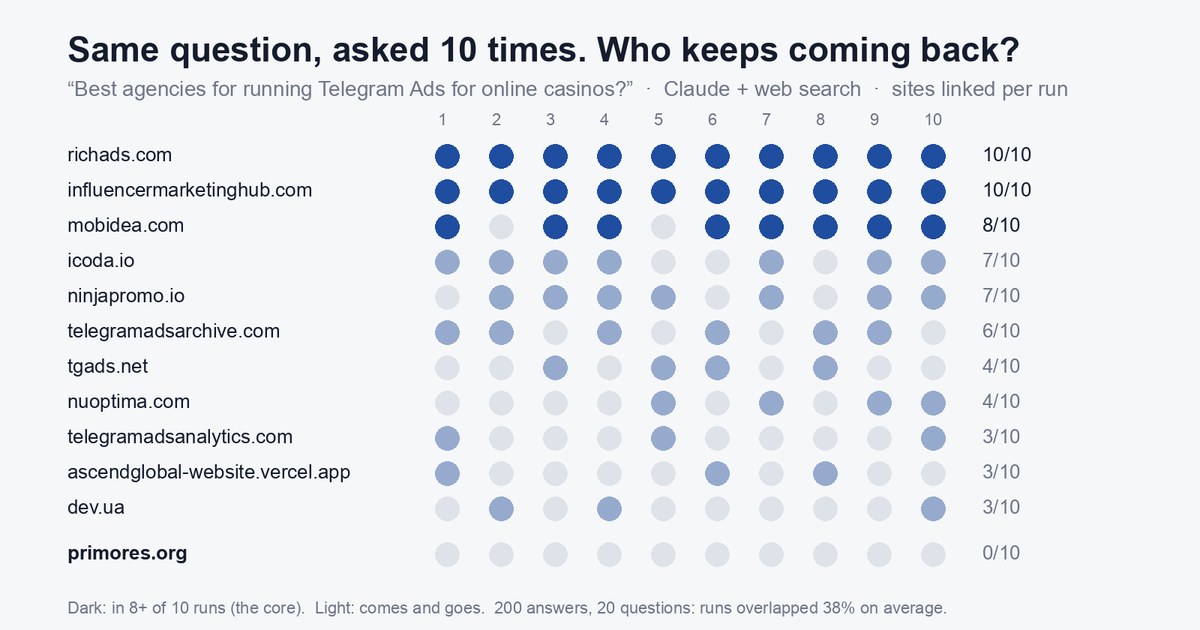
There’s a stable core and a random tail. Almost half the websites showed up once and never again. But each question had a few names that came back nearly every time. RichAds, an ad network, was in all 10 runs of six different Telegram questions. For crypto marketing, coinbound.io and tgads.net were in 10 of 10. That’s the part of the score that’s real.
The position is noise. For “What are the best agencies for running Telegram Ads for online casinos?”, the first website linked was RichAds in 6 of 10 runs and four different sites in the other four. For the Latin America question, the first link was one of six different sites over 10 runs. A tool that reports you as “#2 in ChatGPT” is reporting one draw.
Small sites can sit in the core. One agency was recommended in all 10 runs for “Which companies can run Telegram ads for an iGaming brand?” from a page on a vercel.app address. Another was named from a pages.dev URL, and Claude itself told the reader to “confirm the real website before contacting.” In Claude’s answers, both were described in almost the words of the question. We have a Telegram Ads page and an iGaming page that say the same thing, and we got zero mentions. I don’t know yet why, and I’m not going to pretend one test tells me.
Who came up most across the 140 answers to the iGaming and crypto questions: RichAds, an ad network, in 79; ICODA, an agency, in 63 and across 13 of the 14 questions; Ascend, the agency on the vercel.app page, in 49; NinjaPromo in 44; Awisee in 34; then Telegram ad networks like tgads.net and Adsgram, and the big push and pop networks (Adsterra, PropellerAds). Directories and trade media made up much of the rest.
Two limits of this test, so you read it fairly. It’s one engine (Claude) through the command line, not the ChatGPT app a buyer opens on their phone, and ChatGPT may treat gambling questions more strictly. And I counted linked websites, which mixes recommended companies with cited articles. The pattern still matches what bigger studies found.
Why does the AI visibility score change every time you check?
Because the answers are sampled, not looked up. A public test of this by SparkToro and Gumshoe in January ran 12 prompts 60 to 100 times each on ChatGPT, Claude and Google’s AI, 2,961 runs in total. They found AIs “rarely give the same list of brands or recommendations twice (<1 in 100 times, no matter the question)”. Their advice: run each prompt “usually at least 60-100X”, and treat any tool offering a “ranking position in AI” as “full of baloney.” Gumshoe sells AI tracking, which SparkToro disclosed, and the study isn’t peer-reviewed.
Three more things move the number without anything changing for your business:
- Where the tool asks. Brandlight compared answers from the apps with answers from the same models’ APIs on 900 prompts. Brand overlap was 11% for ChatGPT, 12% for Gemini and 6% for Perplexity. Brandlight sells app-based tracking, so it has a horse in this race, but if your tool uses the API, it’s measuring a different product from the one your customers use.
- How long the answers are. Wil Reynolds of Seer pointed out that when ChatGPT made its answers more than twice as long, visibility scores went up for the same audience: “It’s the same person seeing more answers, right?”
- Which tool you ask. Paul Dyer of /prompt, quoted in Digiday: “If you use three different tools and give them the same prompts, you get three different answers.”
So what is a good AI visibility score?
Not a number out of 100. A good score is a share, read against the leader for the same question. From our runs, I’d sort brands into three bands per question:
- Core: in 80% or more of runs. This is where the leaders sit, usually 2 to 6 names per question in our test. If you’re in this band, you’re part of the answer.
- Edge: in 20% to 79% of runs. You come up sometimes. This is where a change on your site or in third-party mentions could show.
- Noise: under 20%. At most one appearance in 10 runs. Don’t celebrate it and don’t report it to a client.
A good score, then, is being in the core for the questions that bring you buyers, and a bad one is being in the noise while a competitor sits in the core. The comparison with the leader matters more than the absolute figure: on narrow questions like ours, the leader was in 10 of 10, so 4 of 10 is weak. SparkToro noticed something similar: a tight category like cloud providers was steadier than a broad one like science fiction novels.
The bands are mine, drawn from 200 answers on one engine. They’re a starting point to make the number readable, not an industry standard. I couldn’t find a published one.
Does a higher AI visibility score bring more revenue?
Nobody has shown that yet, as far as I could find. Bloomreach says the AthenaHQ deal lets brands “prove the revenue impact of their AI visibility”, but the announcement gives no figure or method. Gartner, in its March market guide, still lists “Attribution and revenue analytics” to map “share of answer” visibility to revenue as an emerging requirement, not something the tools do today.
The people who track this for a living are careful. James Richardson of Optimising, who tracks over 100 Australian brands: “AI visibility is a decent leading indicator. It is not a result.” And the visits AI does send don’t convert especially well, at least in one large study. A Marketing Science paper on 973 ecommerce sites found ChatGPT referrals had a “lower conversion rate and lower revenue per session than every traditional channel except paid social”, though the gap to organic search wasn’t statistically significant in five of twelve versions of their model. I read the summary, not the paper.
That doesn’t make the score useless. It makes it what Richardson says: an early signal, not a sales number. If you want to see the money side, track the visits AI tools do send, which I walked through in how to track AI traffic in GA4.
Is an AI visibility score worth paying for?
Less and less as a separate purchase. In 2026 alone, HubSpot shipped its own tracker at $50 a month and includes it in Marketing Hub Pro and Enterprise, Adobe closed its Semrush deal, Sitecore bought Scrunch, and now Bloomreach is buying AthenaHQ. Gartner predicted it in March: “The market is likely to consolidate as leading platforms expand their offerings and acquire niche players.” Basic tracking starts at €29 a month on Otterly and $95 on Peec AI, and AthenaHQ has a free tier.
So the score itself is cheap. What you pay for, or do yourself, is the reading: enough runs to separate core from noise, and a decision about what to change. Gartner’s own advice to buyers is to “Conduct a preliminary AEO content audit to establish a baseline” before choosing a tool. I’d do that baseline by hand first, it costs an afternoon.
How to check your AI visibility score yourself
This is the exact routine we ran, scaled down for one person.
- Write 10 to 20 buyer questions. Use the words a customer would type, not your brand name: “best X for Y”, “who can do X in Z”, “X vs Y for my situation”. If you sell in several markets, add the country to some of them. Put them in a plain text file, one per line.
- Pick one or two engines your buyers actually use. For most businesses that’s ChatGPT and Google’s AI Mode or AI Overviews. Ask in a logged-out or fresh session, so your own history doesn’t tilt it.
- Ask each question 10 times, in a new chat each time. Save every answer, at least the list of companies and links. If you can script it, Claude Code’s command line (
claude -p "<question>"with web search allowed) is how we did 200 runs without touching a browser. - For each question, count how many of the 10 answers name you, and how many name each competitor. A spreadsheet with one row per question and one column per brand is enough.
- Sort each brand into core (8+ of 10), edge (2 to 7) or noise (0 to 1) for each question.
- Read how the answers describe the core names, then open the page each answer links for them, and compare both with your own page for the same service. In our test, the two small agencies that kept getting named were described in almost the words of the question.
- Repeat in a month, same questions, same engines. Moving from noise to edge on a question you care about is progress. One good run is not.
To check it worked (my rule of thumb, not a standard): if two runs of the whole exercise a week apart give you roughly the same core names per question, 10 runs is enough to see the core. If the core list changes completely, add runs. For a percentage you’d put in a client report, go to SparkToro’s 60 to 100.
Who this is for
Brands and small agencies trying to work out whether AI assistants recommend them, and anyone about to be shown an AI visibility score by a tool or a suite. It’s most useful for narrow, buyer-intent questions (“who can do X”), where a few names dominate. It won’t help much in broad consumer categories with hundreds of possible answers, where the core barely exists. And if your buyers don’t ask AI assistants before buying, which is true in a lot of local and relationship-driven markets, this score isn’t the place to spend your time.
For background on how AI engines pick what to cite, see glossary/geo-aeo.
We’ll re-run the same 200 questions in a month and see whether anything we change moves us out of the zero.
Sources
- Bloomreach, Bloomreach acquires AEO leader AthenaHQ
- AthenaHQ, pricing
- Gartner, Market Guide for Answer Engine Visibility Tools, 9 March 2026 (copy hosted by Siteimprove)
- Machine Relations, AI visibility methodology transparency benchmark
- SparkToro, AIs are highly inconsistent when recommending brands or products
- Brandlight, UI vs API
- No Hacks podcast, AI visibility is a vanity metric, with Wil Reynolds
- Digiday, Marketers question expensive AI visibility tools
- Mediaweek, AI visibility is the new keyword ranking, by James Richardson
- Max Nardit, summary of Kaiser & Schulze on ChatGPT traffic conversion
- HubSpot, AEO tool
- Adobe, Adobe completes Semrush acquisition
- Sitecore, Sitecore acquires Scrunch
- Otterly, pricing; Peec AI, pricing
- Our own test: 20 questions × 10 runs, Claude Sonnet with web search via Claude Code