ChatGPT ads vs Google ads, pros and cons, and which to pick
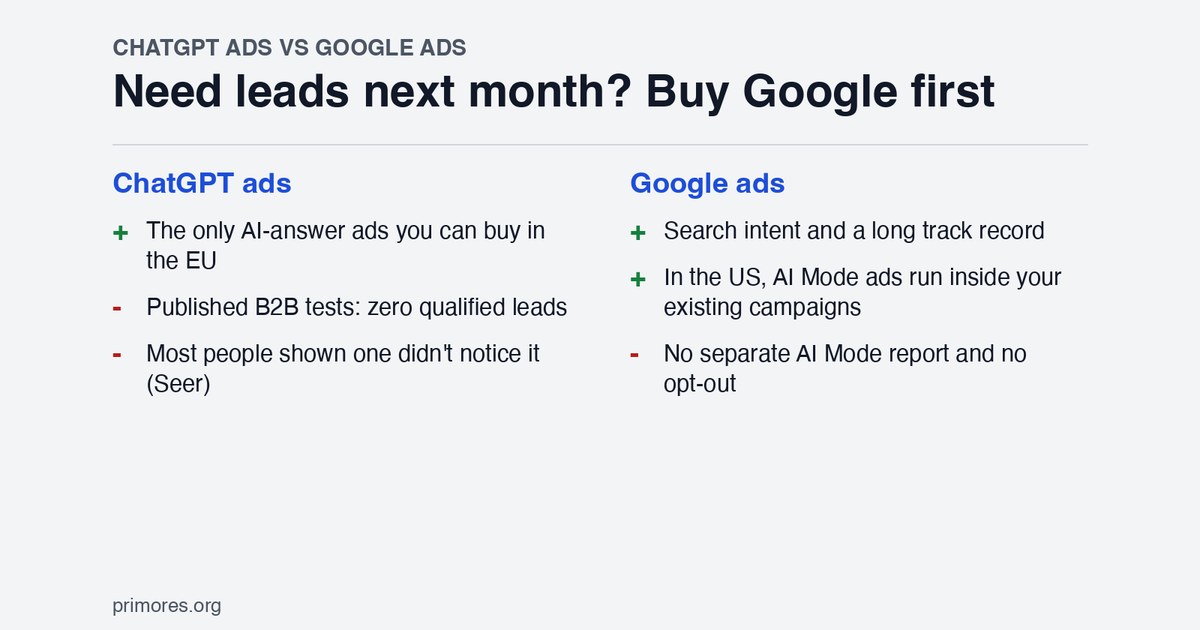
Google ads win on intent and conversions; ChatGPT ads are the only AI-answer ads I found on sale in the EU, and small tests mostly found zero sales.
Should you buy ChatGPT ads or Google ads?
By Andrej Ruckij · November 16, 2026 · OpenAI’s pages blocked our fetch today, so OpenAI facts are labelled with where they come from
TL;DR: If you need sales or leads next month, buy Google. In the US your Search, Shopping and PMax campaigns already serve inside AI Mode, with no opt-out. ChatGPT ads are the only AI-answer ads I found on sale in the EU, but the published small B2B and software tests found zero sales or qualified leads. Treat them as a consumer awareness test at most. Gambling is out on ChatGPT, per secondary coverage and our own earlier read of its policy.
Disclosure: we don’t buy Google or ChatGPT ads for anyone. For iGaming, where ChatGPT ads are closed, we run Telegram Ads instead.
I already wrote up what ChatGPT ads cost, with minimums, billing and every published test, in How much do ChatGPT ads cost?. This piece is the head-to-head. You have a budget, and the question is which of the two gets it.
“Google ads” now means two things, and that changes the comparison. There’s classic Search, the ads next to ten links, and there are ads inside AI Overviews and AI Mode. You don’t buy the second one separately. It comes bundled with the first. So the real choice is between Google (both surfaces, one budget) and ChatGPT (its own account, its own budget, its own ad).
ChatGPT ads vs Google ads, side by side
| Google Search + AI Mode / AI Overviews | ChatGPT ads | |
|---|---|---|
| Where it runs | Search results; inside AI Overviews and AI Mode answers; and since 28 October, on AI Mode follow-up questions in the US | Shown separately from ChatGPT’s answers, for Free and Go users (Euronews) |
| How you buy | ”Existing Search, Shopping, and Performance Max campaigns are automatically eligible” (Google Ads Help) | A separate Ads Manager at OpenAI (details in our cost article, from OpenAI’s help pages read 6 November) |
| Matching | Your keywords. Exact and phrase match get into AI answers only “when a user’s query expresses direct commercial intent”; broad match, Shopping, PMax and AI Max can match to the AI response itself (Google Ads Help) | The conversation, not a keyword list you write (see our cost article) |
| Billing | Your normal Search bids and billing | Per click or per thousand impressions, even on conversion campaigns (our cost article, from OpenAI’s help pages) |
| Reporting for the AI placement | Metrics are “included in aggregate in your standard Google Ads campaign reports” (Google Ads Help). You can’t see AI Mode on its own | Its own reports, since it’s the only placement |
| Opt out of the AI placement | No: “you can’t target ads exclusively to AI Overviews or AI Mode”, and you can’t opt out separately from Search | Not applicable |
| Markets for ads inside AI answers | US, Australia, Canada, India, Indonesia (AI Overviews only), Kenya, Malaysia, New Zealand, Nigeria, Pakistan (text ads only), Philippines, Singapore, English only (Google Ads Help). Brazil, Mexico and the UK planned for Q4 2026 (Google blog). No EU country | 31 European countries since 24 August, which Euronews says brought the total to 40 markets (Euronews) |
| Who never sees the ads | Nobody is excluded by plan | Paid plans. “Ads will only show up on ChatGPT’s Free and Go plans” (Euronews) |
| Gambling | Allowed with certification, in listed countries only (Google Ads policy) | Banned, per secondary coverage (see the iGaming section) |
Ads above and below AI Overviews are a different story. Google says those can run in “all 200+ countries and territories, and all languages, where AI Overviews are available” (Google Ads Help). So an EU advertiser on Google can already show up around AI answers. Just not inside them.
Google ads: pros and cons
What’s good. You pick the queries. Someone typed “industrial label printer price” and your ad shows against it. Nothing in the ChatGPT tests below comes close to that control. You also get a decade of benchmarks, so you know what a good CPC or CPA looks like in your category before you spend a cent. And in the US you get AI Mode inventory without lifting a finger, in the sense that you don’t need a new campaign: the same budget now serves there too. Google told advertisers on 28 October that “click-through rates are already similar between sponsored and organic product list items within AI Mode” (Google blog). That’s Google’s own internal US data, product listings only, no numbers published.
What’s bad. The AI part is a black box. You can’t target it, can’t turn it off and can’t report on it separately. Part of your US Search spend now runs on a surface you can’t see. Google’s own CBO, Philipp Schindler, said on the Q3 call that growth in AI Mode queries “had an impact because of the lower monetization” (Search Engine Roundtable). He also said “Our ad experiments have shown promising results.” Both can be true. Lower monetization for Google just means less ad revenue per query, which tells you nothing about your ROAS. It does tell you Google is pushing to show more ads there.
There’s also the AI explainer problem. Google writes “concise, independent text generated by Google’s Gemini models” next to your ad, and you can’t write, edit or opt out of it (Google Ads Help). If your website says something out of date, that’s what the explainer reads.
And the surface itself is wobbling. On 13 November, Glenn Gabe spotted a test with no AI Mode tab in the search bar and no “Ask anything” box under AI Overviews. Barry Schwartz wrote “I cannot replicate this”, and the post carries no Google statement (Search Engine Roundtable). One observer, unreproduced. I wouldn’t change a budget over it. I’d just note that the inventory Google is selling more of is the same inventory it’s testing hiding behind fewer buttons.
The match-type catch matters more than any of that. If your account runs on exact and phrase match, you’ll mostly be absent from conversational questions. Getting in means broad match or AI Max, and that widens everything, not just AI Mode. I covered what that costs in Is Google Ads AI Max worth it?.
ChatGPT ads: pros and cons
What’s good. It’s the only way I found to put a paid message inside an AI answer in the EU right now. The ad sits below an answer the user just read, so in theory it reaches someone mid-decision. It’s its own budget line, so you can measure it cleanly against your other channels, which you can’t do with AI Mode. And exposure looks to be growing: in Seer Interactive’s small usability sessions, the share of ChatGPT users shown an in-answer ad went from 2 of 22 in March to 12 of 19 in July to September (Seer).
What’s bad. You don’t pick queries. Barn2 called its impression count “unrealistic” and concluded “the ads were being shown to people with no interest in” its products (Barn2). Paying users never see ads, and “Every Plus and Pro session was ad-free” in Seer’s study too. If your buyers are professionals on paid plans, you’re paying to reach the people least like them. In 5 of 6 verticals where Seer tested a branded prompt, the sponsored card under the answer was for a different company than the one named. So your competitor can buy the slot under your own brand question. And the results so far are thin, which is the next section.
What the tests found
Small test means one advertiser’s own campaign under about $5,000, published with numbers. I’ve marked the agency-run and working-paper rows too.
| Who | What | Result | Label |
|---|---|---|---|
| Workshop Digital | B2B, ChatGPT ads | $2,319, 739 clicks, 1.1% CTR, $3.14 CPC, “we didn’t generate a qualified lead”. Its Google Search, in the same post’s comparison table: $6.76 CPC, 5.2% CTR, 2 MQLs | Small test |
| Windmill Strategy | B2B manufacturing and industrial, 22 June to 21 July | $1,470, 259 clicks, 0.66% CTR, $5.68 CPC, 0 conversions | Small test |
| Barn2 | WordPress plugins, 1 June to 14 July | $477, 370 clicks, 0 sales. Visitors from organic ChatGPT answers: 552 sessions, 5 sales | Small test |
| Opascope | One account it runs (“this is our account”), 15 days | About $60K, ~$1.72 CPC, 2.35% CVR, 1.49x ROAS, daily ROAS swinging 0.2x to 2.9x | Agency-run. Opascope says “These are the kind of accounts we run for clients” |
| Kaiser & Schulze via PPC Land | US shops, paid visits, June 2025 to August 2026 | ”$0.89 in revenue against $2.45 for a paid Google search visit”; paid ChatGPT converted at 0.37% against 1.17% | Working paper, descriptive, not causal. One advertiser is 66% of paid ChatGPT purchases. Kaiser advises the data vendor, Grips |
| SE Ranking | Google AI Mode, 50,032 US commercial keywords, 30 June | 29.45% showed a text ad; pets 72.38%, healthcare 2.64%; “Only 11.53% of advertiser domains showed up among the cited sources” | One-day snapshot by a tool vendor |
| Google AI Mode conversions | Anyone | Nothing published. You can’t isolate the placement, so nobody outside Google can measure it | Gap |
Here’s what the table says to me. The three B2B and software tests spent between $477 and $2,319 and got zero. Three tests don’t prove the channel can’t work for B2B. But all three found nothing, and Workshop Digital ran Google alongside and got two MQLs there, on clicks that cost twice as much. Barn2’s number is the sharpest: the same products got five sales from organic ChatGPT visitors and none from paid ones. The only positive result is one account Opascope runs itself, about $60,000 in 15 days, from an agency that sells this work. Even there the daily ROAS swung from 0.2x to 2.9x.
The working paper is the closest thing to a fair comparison, and I’d still hold it loosely. It isn’t peer-reviewed, it’s descriptive, and one advertiser carries most of the paid ChatGPT purchases. PPC Land’s write-up notes that removing that advertiser makes the channel look worse, not better.
On the Google side, nobody knows how AI Mode ads perform. Google says CTR is similar to organic product listings. That’s all.
Do people even notice ChatGPT ads?
Mostly no, in the one study that asked. Seer ran nine usability studies from March to September, 161 recorded sessions, unmoderated, on people’s own AI tools. In the two studies that asked about ads directly, “7 of the 12 participants who were served an ad told us there were none.” Only one person pointed out an ad without being asked: “These are ads. Okay.” (Seer).
The limits are real and Seer names some of them. “What people noticed comes only from what they told us.” Sample sizes by vertical and wave are small. There’s no CTR. And Seer sells ChatGPT ads services (Seer), so it has a reason to make the channel look interesting. Its own advice cuts against the hype, though: “Test ads as an awareness play”, and don’t expect high conversions.
Two readings, and I can’t tell you which is right. Ads people don’t register are bad for clicks. Or they’re a soft brand touch that works the way display used to. My guess is the organic answer matters more than the ad. If ChatGPT already recommends you, the ad reinforces it. If it recommends a rival, your ad sits under someone else’s endorsement. Getting into the answer is the bigger lever, and I wrote about that in How can ChatGPT recommend my business?.
A side note on measuring ChatGPT at all. OpenAI’s new Business Hub shows organic mentions and clicks, and its own tooltip says “Clicks don’t confirm website visits or conversions” (PPC Land). Search Engine Journal’s site showed 353,356 mentions and 2,663 clicks from 14 October to 10 November (SEJ), about 0.75% by my arithmetic. BuildUp Bookings showed 690 mentions and 24 clicks in 28 days, about 3.5% (PPC Land). Being named in an answer rarely produces a click. That’s organic, not ads, but it’s the same audience behaviour.
ChatGPT ads vs Meta ads
I found no published test that ran ChatGPT ads and Meta side by side, so this section is just how I’d think about it.
Meta is interruption. You pick an audience and put a creative in front of them while they scroll. ChatGPT ads sit closer to search, because the user asked something, but the matching is loose and most people don’t notice the ad. If Seer is right that ChatGPT ads are an awareness play, then the honest benchmark is Meta on reach cost and brand lift, not Google on cost per lead. Judge it on what it costs to reach a thousand relevant people, and whether branded search goes up after. Judged on last-click CPA against Google, it’ll look bad every time, and on the tests above, that’s because it is bad at that job.
One EU wrinkle. Euronews says users “will be able to control ad personalisation”, and OpenAI’s own campaign guidance, as we read it on 6 November, told EEA and Swiss advertisers to avoid custom audiences while personalisation wasn’t available there (details in our cost article). Meta’s audience tools are far deeper. If you need targeting, Meta wins easily.
Which to pick
You sell in the US. Start with Google, because you’re already in AI Mode if you run Search, Shopping or PMax. Before adding ChatGPT, check whether you’re showing up in AI Mode answers for your buying questions (the test at the end does this). Add ChatGPT only for a consumer product, and only with a budget you can afford to learn from.
You sell only in the EU. Google has no ads inside AI Mode for you yet, only around AI Overviews. ChatGPT is the only AI-answer inventory I found on sale there. That doesn’t make it a good buy. It makes it the only experiment available. If you’re consumer ecommerce with working purchase tracking, a small, capped test is reasonable. If not, wait. The UK is on Google’s Q4 list, so UK advertisers may get AI Mode ads soon.
B2B lead gen. Google, on the little evidence there is. Three published B2B and software tests, zero leads or sales. If your buyers pay for ChatGPT, they never see the ads. Spend the effort on being the brand ChatGPT recommends, which reaches paying users too, and check your branded prompts on a free account so you know whether a competitor’s card sits under your name.
Ecommerce. Google Shopping and PMax first. They have years of data behind them and now serve in AI Mode in the US. ChatGPT ads are worth a capped test if you can absorb weeks of near-zero return while it learns. The one positive account in the tests spent around $60,000, and Opascope doesn’t say what it sells, so it’s no proof for ecommerce. The working paper says a paid ChatGPT visit is worth about a third of a paid Google visit. Plan for that, not for the best case.
Brand and awareness. This is where ChatGPT ads fit best on current evidence. Seer recommends it, though the low noticing rate cuts both ways. Compare it against Meta and YouTube on reach cost, not against Search on CPA.
iGaming. Google allows online gambling ads with certification, only in the countries its policy lists and under each country’s requirements (Google Ads policy). ChatGPT doesn’t. OpenAI’s ad policy page returned 403 to us today, so I couldn’t quote it first-hand. Casinos.com reported on 2 September that OpenAI’s ad policies, version 1.5, say ads promoting products or services involving a money bet “sono attualmente vietati”, currently banned, covering casinos, sports betting, lotteries and real-money poker, with a narrow exception for hotel or resort ads where gambling isn’t the focus (Casinos.com). When we read OpenAI’s policy page for our cost article on 6 November, gambling was on the disallowed list. So: banned, per one outside report and our own earlier read, neither of them today on OpenAI’s own page. Check the live page before anyone tells you otherwise.
If you can’t decide, the order I’d go in is Google first, then fix your organic presence in ChatGPT answers, then a ChatGPT ads test. The middle step is free and reaches the paying users the ads never touch.
A cheap test anyone can run this week
No media spend, about an hour.
- Write down 10 questions your buyers ask before they buy, the kind your site answers. Add 3 prompts that name your brand (“is [brand] any good”, “[brand] vs [competitor]”, “[brand] pricing”).
- Run all 13 through three places: ChatGPT logged out, ChatGPT on a free logged-in account, and Google AI Mode from a US connection.
- For each answer, log four things: whether a block of links appears above the answer and you’re in it, whether there’s a sponsored card and whose brand it is, whether you’re cited or named in the answer, and in AI Mode, how many ads show and whose.
- Save screenshots. Answers change, and you’ll want the before.
- Repeat in 7 days with the same prompts.
What you’ll learn: whether your competitors already buy ChatGPT ads under your brand prompts, whether you’re in AI Mode’s ad slots at all, and whether the AI answers cite you without you paying. The link block is new. Joe Youngblood reported on 13 November that logged-out ChatGPT showed “a block of 5 links above many of the prompt responses”, while logged-in users got the usual answer (Joe Youngblood). That’s one observer and OpenAI hasn’t said anything, so your own log is worth more than his. If after two rounds you’re cited organically and nobody is buying under your brand, you probably don’t need ChatGPT ads yet. If a rival’s card sits under your brand question, you’ve learned something worth acting on.
Related wiki pages: glossary/ads-in-ai-answers, marketing/alternative-ad-channels, seo/zero-click-strategy, glossary/share-of-model.
Sources
- Google Ads Help: About ads in AI-powered experiences in Google Search
- Google Ads Help: ads in AI Mode (eligibility, reporting, countries)
- Google Ads & Commerce blog: ads in AI Mode, 28 October 2026
- Google Ads policy: gambling and games
- Search Engine Roundtable: Google says AI Mode monetizes lower, 29 October 2026
- Search Engine Roundtable: Google tests dropping AI Mode from the search bar, 13 November 2026
- SE Ranking: Google AI Mode ads study, 14 July 2026
- Euronews: ChatGPT to start showing ads across Europe, 21 August 2026
- Seer Interactive: ChatGPT ads inside answers, 161 AI search sessions
- Seer Interactive: ChatGPT ads services
- Workshop Digital: ChatGPT ads for B2B
- Windmill Strategy: ChatGPT ads B2B industrial and manufacturing pilot
- Barn2: ChatGPT ads results
- Opascope: ChatGPT ads benchmarks
- PPC Land: ChatGPT ad visits earn shops $0.89 against $2.45 for Google search ads
- PPC Land: ChatGPT Business Hub click and mention counts
- Search Engine Journal: SEO Pulse, ChatGPT Business Hub
- Casinos.com: casino and betting ads banned on ChatGPT, 2 September 2026
- Joe Youngblood: ChatGPT experimenting with links above responses, 13 November 2026
- Primores: How much do ChatGPT ads cost? (OpenAI help-page facts on billing, Ads Manager and EEA audiences, read 6 November 2026)