AI Max vs PMax, the real difference and which to use
AI Max is a layer inside a Search campaign; PMax is a separate campaign across all Google inventory, so the pick turns on feed, budget and control.
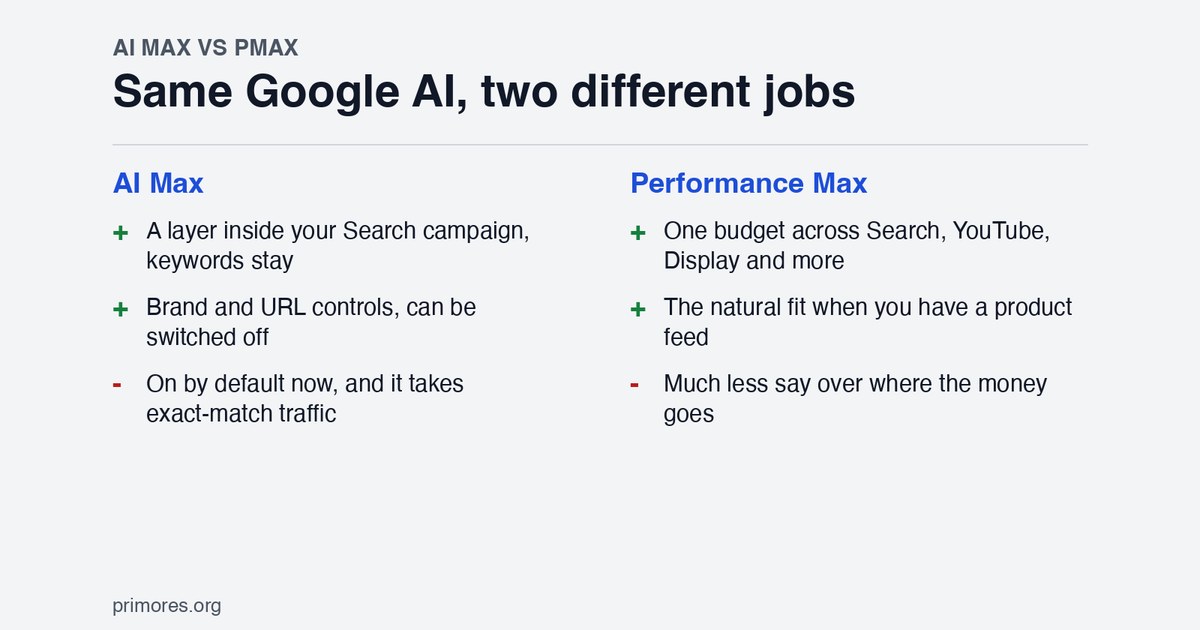
What is the difference between AI Max and PMax?
By Andrej Ruckij · November 16, 2026 · checked on Google’s help pages on 16 Nov
TL;DR: AI Max is a set of switches inside a normal Search campaign. Performance Max is its own campaign, with one budget across all of Google’s inventory. If you sell from a Merchant Center feed, start with PMax. If you sell leads on mostly exact and phrase keywords, run Search and test AI Max as an experiment. Keep it off on brand. AI Max is now on by default in new Search campaigns, and since September 2026 Google has been switching it on in older ones that used automatically created assets or campaign-level broad match. Check before you compare anything.
Primores doesn’t run Google Ads for clients right now, so nothing here comes from our own accounts. It’s Google’s help pages plus the agencies and vendors that published real numbers, and it covers what changed in the last two months.
What is AI Max, and what is PMax?
AI Max lives inside a Search campaign. Google’s help page says “AI Max is not a new campaign type” and lists three parts (Google Ads Help):
- Search term matching “uses broad match, asset-based, and landing page-based technology” to show your ads on searches you never added as keywords.
- Text customization “uses text from your existing ads, landing page copy, and assets” to write ad copy for the search.
- Final URL expansion picks a page on your site, and Google says it “will only send traffic to URLs that are query relevant and themed to your ad group.”
You keep your keywords, negatives and ad groups. AI Max adds reach on top of them.
Performance Max is its own campaign. Google calls it “a goal-based campaign type that allows you to access all Google Ads inventory”, “including YouTube, Display, Search, Discover, Gmail, and Maps, from a single campaign” (Google Ads Help). You give it conversion goals with an optional CPA or ROAS target, plus text, images, videos, data feeds and audience signals, and Google decides where the money goes. Our glossary page has the longer history and the critiques: glossary/performance-max.
The short version: AI Max changes which searches your Search campaign buys. PMax changes which channels your money goes to.
AI Max vs PMax vs Demand Gen: side by side
| AI Max for Search | Performance Max | Demand Gen | |
|---|---|---|---|
| What it is | A setting inside a Search campaign | Its own campaign type | Its own campaign type |
| Where it serves | Search | YouTube, Display, Search, Discover, Gmail, Maps | YouTube, Discover, Gmail, Display Network |
| Keywords | Yours, plus broad and keywordless expansion | No keywords; search themes act as hints | None |
| Product feed | Not needed | Merchant Center feed for retail | Optional, for product ads |
| Who writes the copy | You, unless text customization is on | Mostly Google, from your assets | You, from your image and video assets |
| Who picks the landing page | You, unless Final URL expansion is on | Google can | You |
| Channel control | Search only | Limited (see our glossary page) | Pick channels, down to YouTube Shorts only |
| Click-level split in your tracker | Yes, {search_term_matchtype} | Not listed for PMax | Not applicable |
| Default for new campaigns | On | n/a | n/a |
I’ve put the sources for each row in the sections below.
What are the pros and cons of AI Max?
Where it helps:
- You stay in a Search campaign. Keywords, negatives and ad-group structure still work, and you can switch search term matching off for single ad groups (Google Ads Help).
- The guardrails are real. There are brand inclusions and exclusions, URL inclusions and exclusions, and “locations of interest”, which reaches people “based on their geographical intent even in keywordless matches” (Google Ads Help).
- Google’s claimed upside is biggest for the accounts most people would call conservative. “For campaigns that are still mostly using exact and phrase keywords, the typical uplift is even higher at 27%” (Google blog). That’s vendor-reported, from Google’s internal 2025 data on non-Retail advertisers.
- Since November you can see AI Max clicks in your own analytics or CRM, not just in Google’s report. More on that below.
Where it hurts:
- New volume costs more. Smarter Ecommerce (smec) looked at “more than 250 Search campaigns using AI Max”. Median conversion value went up 13%. Median CPA went up 16%. “Only 22% of campaigns landed close to their original ROAS targets” (Search Engine Journal).
- It eats your exact match. smec looked at 383 million impressions from EMEA ecommerce campaigns that had AI Max on. The share of exact-keyword impressions served by AI Max expansion “climbed from zero to nearly 29% since January 2025”, and roughly two thirds of that came in the last four months to July 2026 (PPC Land). Mike Ryan’s line: AI Max “effectively ‘broad-matchifies’ exact match and phrase match keywords”. In his million-impression sample, exact expansions made up about 80% of AI Max impressions on average (Search Engine Roundtable).
- Pinned ads break. With text customization and Final URL expansion both on, “pinning of RSA assets will not be respected” (Google Ads Help).
- It’s picky about setup. With manual CPC “the full benefits and capabilities of AI Max will be limited” (same page), and “AI Max won’t be effective if campaigns are limited by budget” (Google Ads Help).
- Single tests can look ugly. Xavier Mantica’s four-month test paid $100.37 per conversion on AI Max. Exact paid $52.69 and phrase $43.97 (PPC Land). That’s one account. Take it as a warning.
If all you want is the “should I switch it on” answer, I wrote that one separately: is Google Ads AI Max worth it?.
What are the pros and cons of PMax?
Where it helps:
- It’s the one campaign that reaches everything Google sells, and it plugs into your product feed. Google says you can use it “to promote your online and in-store products” once Google Ads is linked to Merchant Center (Google Ads Help).
- It doesn’t steal your exact keywords. “Search campaigns containing an exact match keyword are prioritized to serve over Performance Max” (Google Ads Help).
- Audience signals give it a head start. Google says they accelerate “campaign learning using high-intent audiences” (same page).
Where it hurts:
- You give up most of the steering. Google picks the channel, and channel spend controls are thin. The details, including the October 2026 caps for Display and Search partners, are on our glossary/performance-max page.
- It has a history of taking credit for brand searches that would have converted anyway. Our glossary page has the Optmyzr overlap numbers, and the November help-text change saying PMax “may” now leave brand queries to Search campaigns.
- Some choices are permanent. “You can’t change the Merchant Center account after the campaign is created” (Google Ads Help).
- You can’t split it out in your own tracker the same way. PPC Land notes the new parameter isn’t listed in the help page’s Performance Max compatibility table (PPC Land).
Where does Demand Gen fit in AI Max vs PMax vs Demand Gen?
Demand Gen solves a different problem. It doesn’t touch Search. Google says it serves “on YouTube, Discover, Gmail, and the Google Display Network” (the same page also mentions Maps elsewhere, so the lists aren’t fully consistent), and it “integrates video and image assets into a single campaign” (Google Ads Help).
The good parts are control and reach to new people. You can “activate Lookalike segments” built from past buyers and site visitors (same page). You can also choose channels by hand, down to serving “specifically on YouTube Shorts”, with reporting by channel at campaign, ad group and ad level (Google Ads Help).
The catch is money and creative. For target CPA bidding, “Google Ads recommends setting a budget that’s at least 10 times your target CPA” (Google Ads Help). And it needs images and video, which is exactly what small advertisers don’t have. If that’s your gap, I covered making them inside Google’s own tools in how to make AI video ads in Google Ads.
Which one serves when AI Max and PMax match the same search?
This matters if you run both (smec says “nearly 50% of accounts” in its set ran AI Max, DSA and PMax together, per Search Engine Journal).
- A Search keyword that exactly matches the query beats PMax (Google Ads Help).
- PMax search themes “carry the same priority as phrase and broad match keywords” (same page).
- When AI Max and PMax both match, “the one with the highest Ad Rank will serve” (Google Ads Help).
- Once you move to AI Max, “broad keywords are not treated as exact match keywords in prioritization”, so Google suggests adding exact-match copies of keywords you need to win (Google Ads Help).
So the AI Max expansion traffic gets no priority over PMax. It’s just two of your own campaigns bidding against each other on Ad Rank. That’s why I’d never judge either one on its own dashboard.
What changed with AI Max between September and November 2026?
Three things. The first two put more accounts on AI Max without anyone deciding to. The third helps you see what it’s doing.
- The September auto-upgrade. Campaigns using automatically created assets or campaign-level broad match “will continue to be auto-upgraded starting in September 2026”. Automatically created assets campaigns come over with search term matching and text customization on, broad-match ones with search term matching on. Dynamic Search Ads follow, with the upgrade to “begin in February 2027” (Google blog). The page describes no opt-out.
- Default-on. “New Search campaigns have the AI Max feature turned on by default”, with text customization and Final URL expansion “enabled by default” too (Google Ads Help). Google Ads Editor 2.14 does the same: “AI Max, text asset automation, and Final URL expansion are now activated by default when creating new Search campaigns” (PPC Land, 12 November).
- A new tracking parameter,
{search_term_matchtype}, reported on 11 November. It returns e, p or b for normal exact, phrase and broad matches, and “a” for AI Max expansions and keywordless matches. Hana Kobzová spotted it (PPC Land).
One number you’ll see quoted isn’t new. Google’s DSA-upgrade post, first published in April and updated in June, says the full feature suite brings “an average of 7% more conversions or conversion value at a similar CPA/ROAS”. Note the comparison is against search term matching alone, not against no AI Max, and it’s again “Google internal data, 2026; for non-Retail advertisers” (Google blog).
If you built a Search campaign recently, or ever used automatically created assets or campaign-level broad match, assume you’re on AI Max until you’ve checked.
How to turn off AI Max in Google Ads
Google’s path (Google Ads Help): go to Campaigns, open the Settings tab, tick the campaigns, choose AI Max, and “toggle to opt out of all AI Max settings.” Save.
Before you do, know what goes with it:
- “When turned off, all of the AI Max features will be disabled” (Google Ads Help).
- Brand exclusions set inside AI Max get switched off too (same page).
- “Existing URL exclusions or inclusions will be ignored if the AI Max settings are turned off” (Google Ads Help).
Often you don’t need the full kill switch. Search term matching can be turned on or off per ad group, and “deactivating text customization automatically disables Final URL expansion” (same page). My default would be to opt out the ad groups that hold brand and your best money keywords, and leave the rest as a test.
How do you check what AI Max is actually buying?
Two places: Google’s report and your own tracker.
In Google, open the search terms report and “add the ‘Source’ column to the default view.” AI Max shows up as its own match type. Watch one trap: filtering for match type “AI Max” “may show lower numbers”, because “this filter doesn’t consider ‘Other search terms’.” Google also says to “wait at least 2 weeks after enabling AI Max” before changes such as negatives (Google Ads Help).
In your own tracker, add the new parameter to the tracking template. PPC Land’s example (PPC Land):
{lpurl}?keyword={keyword}&matchtype={matchtype}&search_term_matchtype={search_term_matchtype}
Then split the clicks the way Google’s ValueTrack page describes (Google Ads Help). AI Max expansion on your keywords is “{matchtype} equals e, p, or b, but {search_term_matchtype} equals a.” Normal keyword traffic is the same with search_term_matchtype “doesn’t equal a.” Fully keywordless clicks show matchtype “a” and a targetid starting “kwl-”, with “kwl-3500001” as the default.
This is the part I actually care about. Until now, a row that said “exact keyword” in your CRM could have been an AI Max click. Now you can put real revenue or qualified leads next to each slice, which is what Ryan keeps telling people to do. The same reflex applies to any automation you hand the keys to. I wrote about it for Meta in can Claude manage Meta ads?: judge on the back end, not on the platform’s own scoreboard.
What’s the case for AI Max that I might be underweighting?
- Location3, an agency, ran AI Max against control campaigns as Google Experiments for a home-services franchise across five locations, December 2025 to January 2026. Conversions rose from “+97%” to “+720%” in every market. CPA improved 63%, 50% and 30% in three locations, stayed flat in one and went “slightly up” in one (Location3). It’s one client with no volumes or significance given, and it’s local lead-gen, which is exactly where ecommerce data says nothing. Their own caveat is the useful bit: “AI Max does not fix weak inputs. It amplifies whatever you feed it.”
- smec’s results run both ways. ROAS ranged from “42% above baseline” to “35% below” (Search Engine Journal). So some accounts win clearly, and the median hides that.
- The 29% isn’t all waste. Adalysis points out that “AI Max expanded matches may include traffic you were already receiving from your exact and phrase keywords” (Adalysis). Some of what’s labelled AI Max is traffic your exact keyword would have won anyway, now under a new label. That cuts against AI Max’s own credit (Adalysis’s heading is “Your AI Max Totals are not incremental gains”). It also means the 29% overstates how much exact budget went to junk. Only your back-end split can size it for your account.
- Google’s three numbers (+14%, +27%, +7%) are all internal, all non-Retail. They might be right for lead-gen. smec’s +13% median sits close to Google’s 14%, but nobody outside Google can check the internal data itself.
I still land in the same place. AI Max finds some extra volume, mostly at a higher price, and the spread between accounts is wide. That makes it something to test, never something to leave on by default, which is unfortunately what Google just made it.
So which one should you run?
It depends on what you sell. Where I found no data, I’ll say so.
Ecommerce with a Merchant Center feed. PMax for the feed, plus a Search campaign with exact keywords on brand and top products. Those exact keywords keep priority over PMax. Test AI Max on one exact-heavy campaign, with the parameter in the template and the read taken in Shopify or GA4, not in Google Ads. smec’s data is exactly this segment. Mike Ryan’s retail analysis, as PPC Land reports it, put AI Max conversions at “approximately 35% lower return on ad spend” than other targeting (PPC Land). Google’s uplift claims explicitly exclude retail.
Lead-gen and B2B. Search first. Google’s AI Max claims are about non-Retail advertisers, so this is where its upside claim lives, and Location3’s franchise test is the one outside result that leans positive. Run it as an Experiment against an exact-and-phrase control for at least the two weeks Google asks for, and judge on qualified leads in your CRM. Form fills alone won’t tell you. On PMax for B2B lead-gen I read no independent data, so I won’t guess.
Brand campaigns. Exact-match Search, with search term matching switched off for those ad groups. There’s no new demand to find on your own name, and an exact keyword beats PMax on that query anyway. If you also run PMax, use brand exclusions there (see glossary/performance-max).
Small budget. Plain Search on exact and phrase, AI Max off, until you can afford not to be budget-limited. Google’s own condition is that AI Max “won’t be effective if campaigns are limited by budget”, and Demand Gen wants a budget of at least 10x your target CPA. No source I read gives a minimum spend for PMax, so that one’s a gap.
Compliance-restricted verticals like gambling. Google requires certification for gambling ads, by country, and landing pages must “prominently display an age warning, addiction resources, terms and conditions” (Google Advertising Policies Help). Final URL expansion lets Google choose the landing page, and text customization writes copy you didn’t approve. I found no data at all on AI Max, PMax or Demand Gen in gambling, and no Google document on how keywordless matching treats certified accounts. Until that exists, I’d keep text customization and Final URL expansion off, use URL inclusions if anything, and treat any expansion as something to prove.
Awareness, video or app-style reach with no search demand yet. Demand Gen. It’s the only one of the three where you choose the channels, and it’s built around image and video.
You run all three already. Check which campaigns are now AI Max (new builds, Editor 2.14 builds, September upgrades), put the parameter in the tracking template now, and compare the whole account’s cost and back-end conversions before and after. Don’t compare campaign against campaign.
Sources
- Google Ads Help: AI Max features and best practices
- Google Ads Help: turn AI Max on or off
- Google Ads Help: AI Max FAQ
- Google Ads Help: AI Max reporting
- Google Ads Help: ValueTrack parameters
- Google Ads Help: about Performance Max
- Google Ads Help: Performance Max with products from Merchant Center
- Google Ads Help: about Demand Gen campaigns
- Google Ads Help: channel controls in Demand Gen
- Google Advertising Policies Help: gambling and games
- Google blog: AI Max for Search campaigns
- Google blog: DSA upgrade to AI Max
- Search Engine Journal: what smec’s data reveals about AI Max
- PPC Land: exact match loses 1 in 4 impressions to AI Max
- PPC Land: independent tests show AI Max underperforms
- PPC Land: new parameter shows when an exact click was really AI Max
- PPC Land: Google Ads Editor 2.14 turns on AI Max by default
- Search Engine Roundtable: AI Max broad-matchifies exact and phrase
- Adalysis: AI Max search term reporting
- Location3: AI Max franchise conversion growth