What does Meta's personal attributes policy ban?
Meta rejects ads that assert or imply a viewer's health, age, religion or money troubles. Here's what's allowed, plus the July 2026 weight-loss changes.
What does Meta’s personal attributes policy ban?
By Andrej Ruckij · November 17, 2026
TL;DR: Meta doesn’t allow ads that “assert or imply the personal attributes of their audience”: their health (including medical conditions), race, religion, age, sexual orientation, disability, financial status and a few more. The test is whether the ad talks about the viewer’s attribute, not whether it mentions the topic. Meta’s own example: “New diabetes treatment available” is allowed, “Do you have diabetes?” isn’t. “You” and “your” are fine as long as they aren’t attached to an attribute. Weight-loss ads sit under a separate Health and Wellness policy, which Meta rewrote on July 22, 2026. Before-and-after images are no longer banned as a format. What’s banned is copy that attacks someone’s appearance, close-ups of pinched fat, results claimed from wearables alone, and specific results in a set time without a qualifier. Weight-loss ads must target people 18 and over.
When we write and produce ads for clients, our scenario tool reads every line of copy for personal attributes before the client sees it. It reads for the idea behind this rule. Below is the rule itself, taken from Meta’s own policy pages.
What is Meta’s personal attributes policy?
It’s one of Meta’s Advertising Standards, now filed under “Privacy Violations and Personal Attributes”. Meta’s reasoning: “Ads that make assumptions about people could be perceived as intrusive, unsettling or inaccurate.” So advertisers can’t run ads “that assert or imply the personal attributes of their audience.” Instead, “ads should focus on the benefits of the product or service being advertised.”
The attributes it covers are “direct or indirect assertions or implications” about a person’s:
- race, ethnicity, religion or beliefs
- age
- sexual orientation or practices, gender identity
- disability, physical or mental health (including medical conditions)
- vulnerable financial status
- voting status, membership in a trade union, criminal record, or name
Weight isn’t on that list by name. My reading is that it gets caught when it’s framed as health, and for weight-loss products the Health and Wellness policy (below) does most of the work anyway.
Meta’s page says ads can’t “Share or ask for personal attributes of a user or user’s family”, can’t “Imply that the advertiser is aware of someone’s personal attributes”, and can’t “Imply knowledge of Medical information of a user or user’s family.” The old URL for this policy now returns a 404, so if an older guide links to it, that’s why.
Allowed vs rejected: Meta’s own examples
These pairs are straight from Meta’s policy page. They’re the clearest way to see where the line is.
| Allowed | Not allowed |
|---|---|
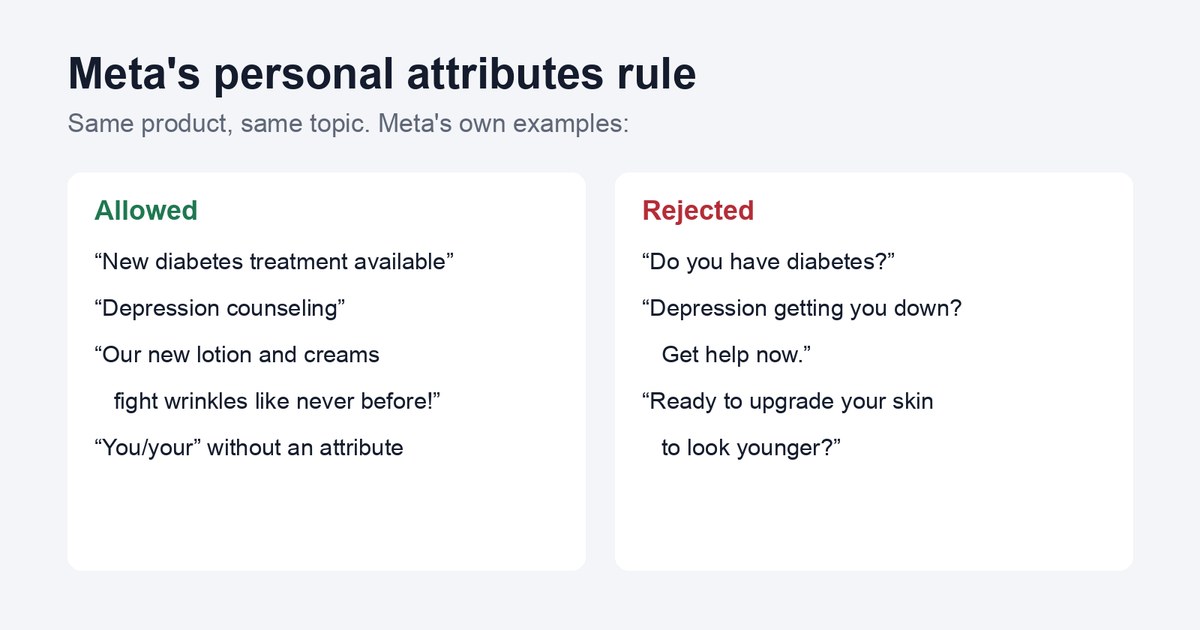
| ”New diabetes treatment available" | "Do you have diabetes?" |
| "Depression counseling" | "Depression getting you down? Get help now." |
| "Our new lotion and creams fight wrinkles like never before!" | "Ready to upgrade your skin to look younger?" |
| "Bulimia counseling available" | "Don’t wait!! Get your spouse treated for cancer today with help from our medical experts.” |
In the first three rows the topic is the same on both sides; only the framing changes. The left column describes what’s offered. The right column asks about, or assumes, the condition of the reader or their family, which is why the cancer line fails too.
Can you use “you” in Meta ads?
Yes. It’s a common misunderstanding, and some agencies still tell clients to avoid second person entirely. Meta’s page lists, under what ads can do: “Use “you/your” language without a personal attribute.” What it rejects is “Using the word “you/your/other” to reference a personal attribute.”
So “Your new running plan starts Monday” is fine. “Your back pain ends Monday” isn’t, because it tells the reader they have back pain. Meta also allows a “passing reference to a personal attribute”, including “gender, age groups or age ranges”, so “a running plan for women over 40” describes who the product is for without claiming the reader is one.
Meta’s weight loss ads policy in 2026
Weight-loss, weight-gain, cosmetic and supplement ads follow Meta’s Health and Wellness policy on top of the personal attributes rule. Meta changed it on July 22, 2026, and a lot of what’s online hasn’t caught up.
The overview: Meta “restricts advertising content that promotes weight loss or weight gain products, cosmetic procedures, and dietary or health supplements from targeting users under 18 years of age.”
Here’s what the current text bans:
- “statements of inferiority about physical appearance (i.e., terms, descriptions, or questions that are negative and attack an individual’s appearance, specific body parts, or hygiene)”
- a “Close up on specific body area by pinching fat”
- “Claims that results can be achieved solely by using wearable products”
- clickbait such as “sensational language with exaggerated or extreme claims, or promises of specific outcomes within a set timeframe without disclaimers or qualifiers”
- claims to cure incurable diseases such as diabetes, thyroid conditions or psoriasis. Meta adds that this “does not apply to claims about treating or managing symptoms of these conditions.”
What changed in July: the older version banned ads that “imply or attempt to generate negative self-perception or declare there is a perfect body type”, and banned “Side-by-side comparison after the use of a product or transformation for weight loss”. Both lines are gone from the current policy. They only appear in the page’s dated version history.
Are before-and-after photos allowed in Meta weight loss ads?
As a format, yes again, with conditions. For dietary weight-loss products targeted to adults, the current policy says the ad can show people using the product and its impact, and must “clearly indicate the time taken to achieve noticeable results.” General cosmetic products and procedures “depicting before and after transformation” are also allowed for 18+ audiences.
What still gets an ad rejected is what you put around the photo. Clikim, an ad-account vendor, summed it up the day of the change: “Content is prohibited only when paired with violative claims.” By its reading, “feel stronger after 12 weeks” next to a before-and-after is likely fine, while “lose 10kg in 10 days” still breaks the rule.
Two warnings. One page updated in September 2026 still says Meta bans before-and-after for weight loss, so don’t trust a guide just because it’s recent. And nobody has published data on how Meta’s automated review behaves since the change. Expect some rejections the text doesn’t justify, and keep the appeal route handy.
GLP-1 and prescription weight loss ads on Meta
Prescription weight-loss products fall under Meta’s Drugs and Pharmaceuticals policy, not Health and Wellness. Online pharmacies and telehealth providers must be “actively certified with LegitScript”, then “request authorization from Meta.” Ads can “Only target people in eligible countries (United States, Canada or New Zealand)” and “Only target people 18 years or older.” Ads that “Promote telehealth services generally” don’t need written authorization.
Meta’s text doesn’t mention GLP-1s, semaglutide or compounded drugs by name. The bigger risk there sits with the regulator: in March 2026 the FDA warned 30 telehealth companies, naming “claims implying sameness with FDA-approved products” as a main problem.
The data side: custom conversions named after a condition
The personal attributes idea now reaches your tracking too. Meta’s developer docs say that from September 2, 2025, “any custom conversion suggesting specific health conditions (e.g., “arthritis”, “diabetes”)” will be “flagged and prevented” from running ads, and “You won’t be able to use flagged custom conversions when creating new campaigns.”
One agency, Accelerated Digital Media, reports the same for custom and lookalike audiences whose names or rules imply a sensitive trait. It adds a caution worth repeating: neutral naming “avoids an automated disablement”, but “It does not make the list eligible.” Renaming “diabetes_leads” to “lead_form_3” hides the label, not what the audience is. If you’re setting up tracking for a health brand, my comparison of the Meta Conversions API and the pixel covers the plumbing.
How to rewrite a rejected Meta ad
- Find the “you + condition” phrase. Look for questions (“Struggling with…?”, “Do you have…?”) and possessives (“your belly fat”, “your anxiety”). That’s almost always the trigger.
- Swap the reader’s condition for what the product does. Meta’s own pattern: “Depression getting you down?” becomes “Depression counseling”. Ads Uploader, an ad-tool vendor, gives weight-loss rewrites in the same shape, for example “Are you overweight?” to “Structured weight-management support for adults.” and “Struggling with belly fat?” to “A nutrition and activity plan built around real schedules.”
- Check the visuals. No pinched-fat close-ups. A before-and-after is allowed for adults, but say how long the result took.
- Check every number with a time on it. “In 30 days” needs a qualifier, or cut it.
- Set the age to 18+ for anything with a weight, cosmetic or supplement claim. Meta exempts general fitness services and protein food, but if the ad makes a weight claim, don’t rely on the exemption.
- Check custom conversions and audiences in Events Manager and Audiences. Any with a condition in its name or rules (“diabetes_leads”, “visited /weight-loss-quiz”) is likely to get flagged. Rebuild it on a neutral event, like a completed form or a purchase.
- Resubmit, or request a review. Meta says review “is typically completed within 24 hours”, and you can “request another review if they believe their ad was incorrectly rejected.”
To check it worked: read the ad as a stranger would. If it tells them something about themselves that they didn’t say, it’ll likely be rejected again.
What happens if Meta rejects your ad
Meta’s review is “primarily” automated. A rejected ad can be sent for another review in Account Quality. Repeated problems are what hurt: Meta restricts accounts for “Severely or repeatedly violating our policies”, and a restricted account appeals through Business Support Home, where review is “typically” done in 48 hours. One rejected ad isn’t a crisis. A pattern of them on the same account is, so fix the copy rather than resubmitting the same line over and over.
For AI-made creative, where it’s easy to generate fifty versions with the same bad hook, I wrote about making AI UGC ads that hold up.
Who this is for
Health, fitness, nutrition, supplement, beauty, mental-health and telehealth brands running Meta ads, and the agencies writing their copy. The personal attributes part also covers financial status, religion, age and the other attributes on Meta’s list. It doesn’t cover local law on top of Meta’s rules, like the UK ASA or EU health-claims rules, which can be stricter.
Sources
- Meta Transparency Center, Privacy Violations and Personal Attributes
- Meta Transparency Center, Health and Wellness
- Meta Transparency Center, Drugs and Pharmaceuticals
- Meta Transparency Center, Advertising Standards
- Meta, Ad review policy guidelines
- Meta for Developers, Conversion tracking
- FDA, FDA warns 30 telehealth companies
- Ads Uploader, Weight loss ads on Facebook
- Clikim, Meta health and wellness policy update
- Accelerated Digital Media, Social media health ad restrictions 2026
- adplay, Before-and-after ads (an example of the outdated claim)